There is a number making the rounds in Olympia this week, and it is doing what big round numbers do: flattering some people, insulting others, and explaining almost nothing on its own.
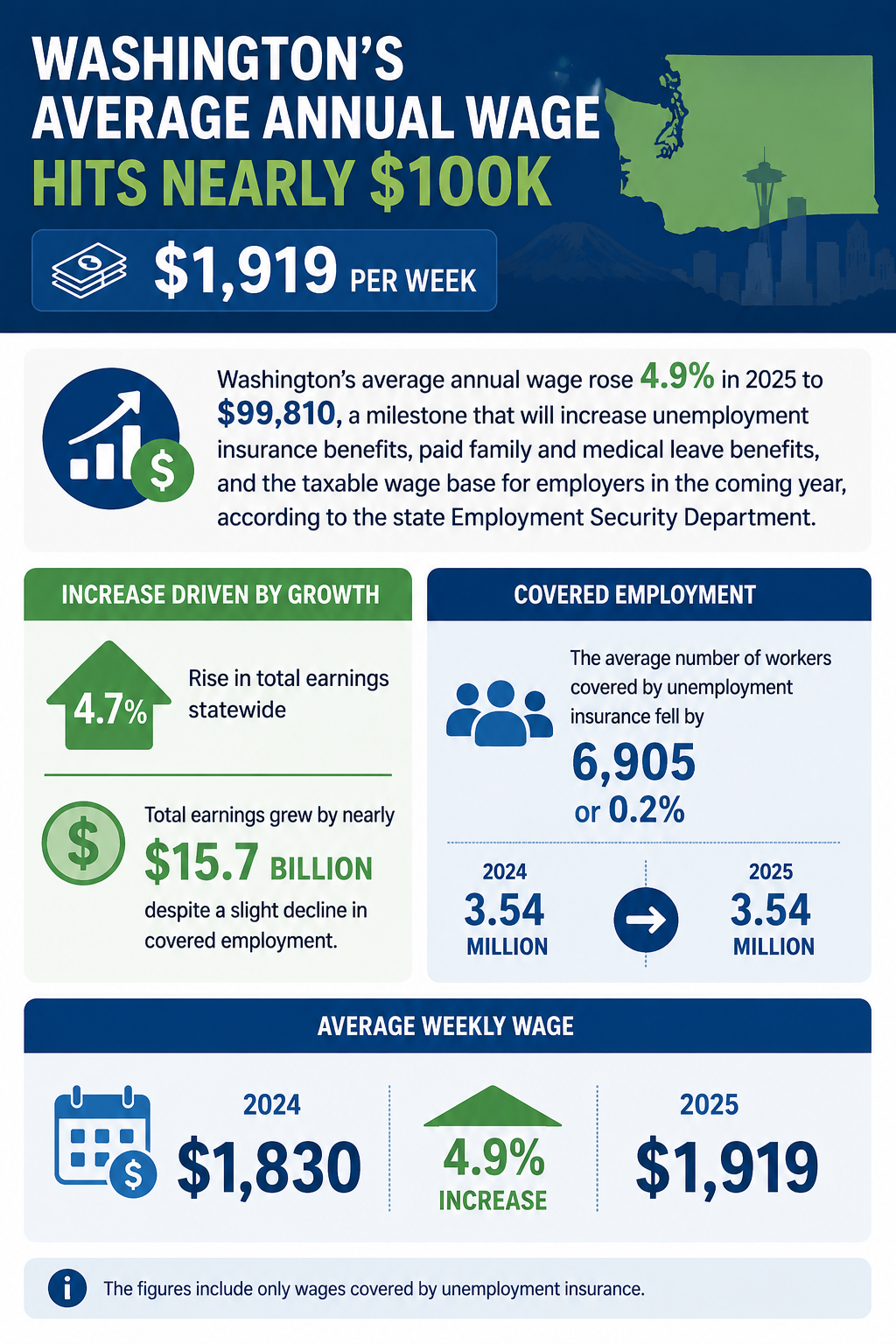
The number is $99,810. That is what the average worker in Washington State earned in 2025, according to figures released by the state Employment Security Department — a 4.9 percent jump from the year before, and close enough to six figures that the headlines have already rounded up. Broken into weekly installments, it comes to $1,919, the kind of paycheck that, a generation ago, would have signaled unambiguous arrival. The state's average annual wage was $89,138 as recently as 2023. It has gained more than ten thousand dollars in two years, a pace that would be cause for celebration if the story behind it were as simple as the arithmetic.
It is not. Consider one detail buried in the same release: total wages in the state grew by nearly $15.7 billion last year, while the number of workers covered by unemployment insurance actually fell — by 6,905 people, a small but telling decline. The pie got dramatically larger; the number of people sharing it got smaller. An average, after all, is just a sum divided by a count, and there are two ways to push it upward. One is for everyone to get a raise. The other is for the people at the bottom of the distribution to quietly disappear from it.
Washington in 2025 experienced some of both. The sectors that drove the wage gains tell their own story: professional, scientific, and technical services — the consultants, the engineers, the people whose business cards say things like "principal" and "staff" — saw average wages rise 12.5 percent. Finance and insurance climbed 8.7 percent; the information sector, which is the statistical drawer where much of the tech industry lives, rose 8.4 percent. These are the best-paid corners of the state's economy, and they got better paid faster than anyone else. When the highest wages grow the fastest, the average rises like a hot-air balloon, whether or not anyone on the ground feels lifted.
Meanwhile, the ground itself has been shifting. Washington's unemployment rate, which sat at 4.4 percent in January 2025, climbed steadily through the year and crossed 5 percent in early 2026 — the highest level since 2021, according to the Employment Security Department's own monthly reports. By April it had reached 5.2 percent, after four consecutive months of job losses. Anneliese Vance-Sherman, the department's chief labor economist, has been narrating this slide with the careful understatement of her profession: the labor market, she said this spring, "has been losing momentum over the past couple years," and the rising unemployment rate signals "an increasingly challenging labor market for job seekers." What makes the trend stranger is that for much of this period the national rate was moving the other way. In December 2025, when Washington's rate ticked up, the country's ticked down. A state that has long prided itself on outperforming the national economy found itself, for the first time in years, underperforming it.
Part of the explanation sits in the glass towers of South Lake Union and Redmond. More than 11,000 tech workers in Washington lost their jobs between May 2025 and April 2026, according to research from the workforce-intelligence firm Revelio Labs shared with KUOW — second in the nation, behind only California. Microsoft cut roughly 2,000 Washington positions in a single May 2025 round and thousands more over the following months; Amazon's October announcement of 14,000 corporate cuts included more than 2,300 in Washington, and the company followed with an even larger global round in early 2026. A Bloomberg analysis found that more than 40 percent of the Washington layoffs in one wave targeted software engineers — people who had, in some cases, been instructed months earlier to lean harder on the AI tools that their employers were spending historic sums to build. At a Seattle City Council hearing this June, an Amazon Web Services engineer named Patrick Schloesser did the math out loud: his company spending $200 billion on capital this year, mostly data centers and AI, while laying off 30,000 corporate employees in eight months. The companies dispute the causal chain; the spreadsheet does not much care.
Here is where the story folds back on itself, in a way that feels almost designed by a novelist with a taste for irony. Washington indexes its social safety net to the average wage. The new $99,810 figure will be used to recalculate unemployment benefits for claims opened on or after July 5, 2026: the minimum weekly benefit rises by $17, to $383, and the maximum by $56, to $1,208. The maximum weekly Paid Family and Medical Leave benefit climbs from $1,647 to $1,727 for claims filed in 2027. The taxable wage base — the slice of each employee's pay on which employers owe unemployment taxes — grows from $78,200 to $82,000. Which means that the wage growth produced, in part, by eliminating jobs will now fund somewhat more generous support for the people whose jobs were eliminated. The laid-off Amazon engineer drawing the new maximum benefit next fall will be collecting a check whose size was inflated by the very dynamics that put her on unemployment. There is a certain bleak elegance to it, like a machine that lubricates itself with its own friction.
And then there is the question of where, exactly, the average Washingtonian lives — because statistically speaking, she lives almost nowhere. The federal Bureau of Labor Statistics, surveying the state's counties in early 2025, found average weekly wages ranging from $2,675 in King County to $903 in Wahkiakum, on the Columbia River — a nearly threefold spread inside one state. The state Office of Financial Management's longer view is just as stark: in 2023, King County's average wage of roughly $122,700 stood alone above the state average, with no other county even reaching it. Reporting by the Washington State Standard noted that in twenty-three of the state's thirty-nine counties, the average annual wage was under $60,000. The statewide average of $99,810 is, in this light, less a portrait of a typical worker than a kind of optical illusion produced by holding King County too close to the lens. A home health aide in Okanogan County and a cloud architect in Bellevue are averaged into the same number, and the number resembles neither of them.
Even in the place that produces the high wages, the high wages have a way of evaporating on contact with the cost of living. A study by Upgraded Points, drawing on Economic Policy Institute and Census data and reported by KOMO News last fall, calculated that a single adult in the Seattle-Tacoma-Bellevue metro needs $135,265 a year to live "comfortably" under the standard 50/30/20 budget rule — the sixth-highest threshold among large American metros. For two adults with two children, the figure was over $300,000. SmartAsset's 2026 update of its own version of this exercise puts Seattle among the handful of cities where six-figure incomes are simply the table stakes of financial stability. Set those benchmarks against the new state average and the milestone deflates: the average Washington worker, earning very nearly $100,000, falls some $35,000 short of what it takes for one person, with no children, to live comfortably in the state's economic engine room. The Employment Security Department, for its part, includes a quiet caveat in its release — the figures are not adjusted for inflation — which is the statistical equivalent of a wink.
None of this means the number is meaningless. For tens of thousands of households, the recalculated benefits will be the difference between a hard season and an impossible one; an extra $56 a week on an unemployment check is groceries, or a phone bill, or the co-pay that doesn't get skipped. For employers — especially the small ones in those twenty-three counties where the average wage is closer to $55,000 than $100,000 — the larger taxable wage base is a real cost, levied to insure against a labor market whose turbulence was generated mostly somewhere else. Washington's unemployment system is experience-rated, meaning a company's taxes rise with the benefits its former workers draw; the bill for the tech industry's restructuring will be itemized, eventually, across the whole economy.
What the number cannot do is settle the question it raises, which is what kind of prosperity this is. A state can grow richer on paper while growing more anxious in fact; it can post record average wages in the same twelve months that its labor economist describes a market "increasingly challenging for job seekers." Washington has always been a place of extravagant averages — the rainfall, the evergreens, the stock grants — and it has always asked its residents to do the private arithmetic of figuring out where they stand relative to the mean. This year the arithmetic is harder than usual. The average Washingtonian earns almost a hundred thousand dollars. She is also, depending on the county, the industry, and the month, earning half that, or twice it, or newly drawing $383 a week and refreshing a job board. The number is true. It is the singular noun — the average worker, as if there were one — that has stopped being honest.