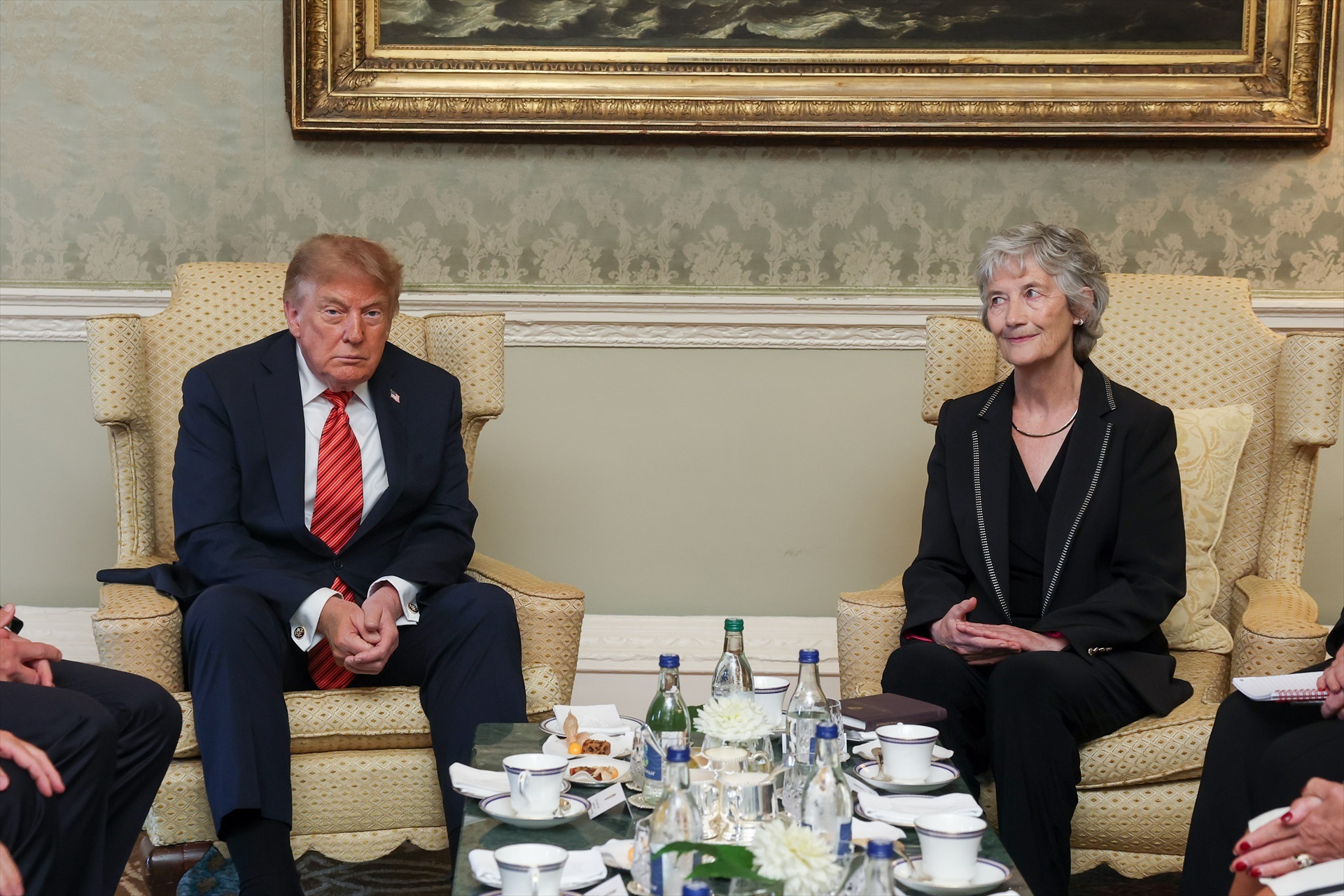
Venezuelan media are closely following Donald Trump’s foreign-policy moves—from his support for the war with Iran to statements about possible mediation in the dispute over the Malvinas (Falkland) Islands and his endorsement of Irish reunification. These stories show how the personal diplomacy of the U.S. president can strain relations with traditional allies, influence conflicts, and pose questions of sovereignty in new ways. This review is based on materials from Instagram (Venezuela) and Orain.eus (Venezuela).
Trump’s Remarks on Ireland Spark Sovereignty Debate
Donald Trump’s statement that Irish reunification would be desirable was not merely an episode during his visit to Dublin. It also prompted a new discussion about the limits of external interference in matters of national self-determination. According to Orain and a post circulated by a Venezuelan source via Instagram, the U.S. president said he “would like to see” a united Ireland and was certain that “sooner or later, it will happen.”
Trump called Irish Prime Minister Micheál Martin “the right person” to begin the process. At the same time, he acknowledged that the United Kingdom “will also have something to say.” According to the reports, the American leader also said he was ready to play the role of the “right person” to initiate discussions, although his trip to Ireland was largely connected with a private visit and golf.
Such remarks are particularly sensitive in Northern Ireland. The island’s current political arrangement took shape after the partition of Ireland in 1921. The ensuing conflict between unionists, who supported keeping the region within the United Kingdom, and Irish nationalists lasted nearly three decades, claimed more than 3,500 lives, and ended with the political settlement established by the Belfast, or Good Friday, Agreement of 1998.
The agreement provides for the possibility of a referendum on Northern Ireland’s constitutional future, but the issue must be addressed through the established legal process and only when there are grounds to believe that a majority of residents might support change. This is why Trump’s remarks drew criticism from British and Northern Irish politicians.
Gavin Robinson, leader of the Democratic Unionist Party, stressed: “The people of Northern Ireland will decide the territory’s constitutional status—not comments from London, Dublin, or Washington.” A Downing Street spokesperson, meanwhile, said that a new referendum would be impossible without clear public support. Conservative Party leader Kemi Badenoch called Trump’s comments “frivolous” and said they were creating “unnecessary tension.” She compared them with the U.S. president’s earlier remarks about the possible annexation of Greenland or Canada.
The Venezuelan reading of this story centers primarily on the issue of sovereignty. The reports do not include direct comments from Venezuelan authorities, politicians, or experts, but the choice of subject fits Caracas’s familiar view of international relations. For decades, Venezuela’s official rhetoric has emphasized noninterference, national independence, and the right of peoples to determine their own political systems.
From this perspective, the U.S. president’s words can be interpreted in two ways. On the one hand, the aspiration for Irish reunification can be associated with overcoming Britain’s colonial legacy, the history of a divided island, and the right to self-determination. On the other hand, public support from the leader of a foreign power for a specific outcome may appear to be an attempt to influence an extremely delicate domestic and regional debate.
This aspect is particularly important for Venezuela. Caracas regularly accuses Washington of using diplomatic, economic, and political pressure to influence the internal processes of other countries. Against the backdrop of sanctions, international disputes, and the politicization of the Venezuelan agenda, Trump’s remarks on Ireland may be seen as another reminder that influential states often publicly signal their preferred outcomes in conflicts that, according to supporters of the principle of noninterference, should be resolved exclusively by the people of the territories concerned.
Thus, the story has gone beyond the debate over Northern Ireland’s future. It has once again raised the question of where the line lies between expressing a political position and interfering in the sovereign affairs of other states. In both the Irish and Venezuelan contexts, the answer comes down to one principle: the final decision about a territory’s borders, status, and future should belong to its residents, not to foreign leaders.