Venezuelan media portray the United States and Donald Trump as an increasingly destabilizing force on the international stage. The focus is on concerns over possible escalation involving Iran and oil shipments, Washington’s role in diplomacy over Ukraine, and opposition from neighboring and allied countries to Trump’s rhetoric, immigration policy, territorial claims, and pressure on partners. The overall tone of the coverage is one of international concern and resistance to U.S. actions. This material was prepared based on posts from Facebook (Venezuela) and Telemundo (Venezuela).
Trump, “America,” and Venezuela’s Concerns About U.S. Pressure
Two reports on Donald Trump’s actions and economic policies paint a picture that may be particularly sensitive for Venezuelan audiences. One concerns a symbolic gesture—a modified map of New Mexico—while the other focuses on the gap between the White House’s economic promises and the United States’ actual performance. Although neither the Reporte Índigo post nor the Telemundo report prepared by the Associated Press includes direct comments from Venezuelan politicians, experts, or officials, both topics can easily be interpreted in Caracas through the experience of sanctions, oil disputes, currency turmoil, and years of confrontation with Washington.
Trump posted a modified map of the U.S. state of New Mexico on Truth Social. On it, the word “México” is crossed out and replaced with “América,” while the state itself is renamed “Nueva América.” Formally, this is a social media post and a visual provocation, but for Latin American countries such imagery may carry a much broader political meaning.
The replacement of “Mexico” with “America” is particularly significant. In Latin American cultural and political tradition, America refers to the entire continent, including North, Central, and South America, rather than solely the United States. Therefore, using América as a synonym for the United States is often perceived as one country appropriating a shared continental identity and erasing the agency of the region’s other states.
For Venezuela, whose political discourse has for many years been built around sovereignty, Bolivarian integration, and resistance to external interference, this symbolism could provoke a particularly strong response. The authorities and pro-government media could present the post as an illustration of what they call the “imperial” approach of the United States: an attempt to define not only the rules of international politics and access to resources, but also the symbolic boundaries of the region.
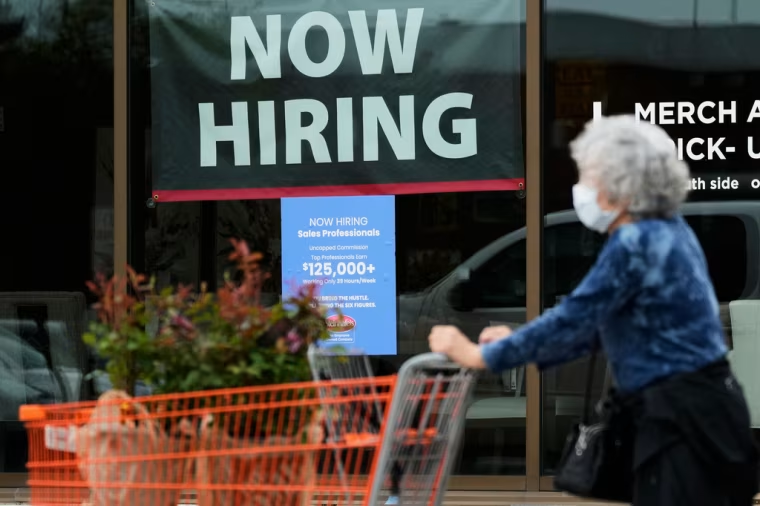
Against this backdrop, the economic agenda of the Trump administration is no less important for Caracas. Telemundo and the Associated Press describe how promises of a rapid industrial revival, lower prices, and an economic boom are colliding with persistent inflation, expensive credit, rising public debt, and relatively modest economic growth. The U.S. president stated: “Success does not cause inflation. Stupidity causes inflation.” However, the report notes that inflationary pressure is attributed in part to Trump’s tariff policy and an oil shortage caused by the war with Iran.
RSM economist Joe Brusuelas believes that confidence in the administration has been undermined by “excessive forecasts that do not correspond to economic reality.” His assessment is especially understandable to Venezuelans familiar with situations in which declarations of an imminent recovery are not accompanied by stable monetary policy, increased investment, stronger institutions, and greater purchasing power for the population.
Trump is also demanding lower interest rates and promising GDP growth of “12, 13, 14, 15%.” Critics, by contrast, warn that cheaper money could intensify inflation. For a country that has experienced hyperinflation and a deep currency crisis, the debate over central bank independence does not look like an abstract American discussion, but rather an issue with clear social consequences—from the erosion of incomes to currency shortages and declining confidence in the national monetary system.
Administration representative Christopher Felen defends the White House’s economic course, expecting artificial intelligence, tariffs, and tax cuts to raise productivity. Economist Ernie Tedeschi calls such optimism “excessive” and emphasizes that government policy should not be built around the most favorable scenario.
According to the Telemundo report, the U.S. economy is growing by approximately 2% a year, while inflationary pressure persists, the national debt exceeds $40 trillion, and approval of Trump’s economic policies has fallen to 32%. For Venezuela, these figures matter not only as an indicator of the condition of the world’s largest economy. Higher U.S. interest rates, trade conflicts, and slower global growth can affect demand for and the price of oil, developing countries’ access to financing, and the stability of international markets.
For Caracas, this is directly connected to export opportunities, oil licenses, U.S. sanctions decisions, and negotiations over restrictions in the energy sector. Any changes in U.S. policy can affect Venezuela’s revenues and its ability to attract external financing.
In this context, the “New America” map and the debate over the state of the U.S. economy converge around a common theme: Washington’s influence on Latin America. The symbolic post may be perceived as a sign of a claim to political and cultural dominance, while White House economic decisions can alter the region’s trade conditions, borrowing costs, and oil revenues.
The sources do not cite a direct Venezuelan reaction to these episodes. However, for a country whose modern politics have been shaped largely by conflict with U.S. pressure, they may reinforce a familiar suspicion: that the United States sees Latin America not as a community of equal states, but as a sphere of its own influence. At the same time, the story of the U.S. economy serves as a reminder that loud political promises, tariffs, and pressure on financial institutions cannot replace market confidence, consistent policy, and genuine economic growth.