By September 8, 2026, discussion of America in Japan, Turkey and Ukraine has come to revolve around the same feeling: Washington is once again capable of changing the rules of the game overnight—but is no longer necessarily able to ensure a stable order on its own afterward. The most prominent issues in recent days have been the renewed US-Iranian military escalation and the threat to shipping through the Strait of Hormuz, a new attempt by Donald Trump’s team to restart negotiations on Ukraine, and the impact of US inflation and Federal Reserve policy on vulnerable economies. Yet in each of the three countries, the United States is viewed through the lens of its own concerns: in Japan, through energy security and fears over the destruction of international law; in Turkey, through the opportunity to strengthen Ankara’s role as a mediator and ally; and in Ukraine, through anxiety that the White House’s desire for a “deal” may prove more important than a just peace.
The most tangible American problem for Japan and Turkey at present is not diplomatic rhetoric but oil. Following a new round of US-Iranian strikes, markets are once again focused on the Strait of Hormuz, through which a critical share of Middle Eastern supplies passes. For Tokyo, this is almost an existential issue. Energy analyst Nobuhide Kiuchi warns in an analysis by the Nomura Institute that a return of WTI to above $90 per barrel could add around 0.3 percentage points to Japanese inflation and increase annual household expenses by approximately ¥13,000. His main conclusion is particularly telling: American oil has become a temporary safety net for Japan amid the Middle Eastern crisis, but that safety net is not unlimited. The expected reduction in US shipments in September shows that even an allied energy lifeline depends on commercial contracts, domestic demand in America and the military situation.
Japan’s response therefore differs noticeably from the familiar Western discussion of “containing Iran.” The central question is not so much who will win, but whether predictability can be restored to maritime routes and international rules. In a recent editorial in the Asahi Shimbun, the US reliance on overwhelming military force is described as a dangerous simplification that does not produce a political solution. This perspective is important in Japan’s public discourse: a country dependent on imported resources and maritime trade views US coercive policy not as distant geopolitics, but as a direct risk to prices, industry and its own strategic position in East Asia. This gives rise to an underlying concern: if Washington can so easily set international norms aside in the Middle East, how convincingly will it be able to demand that they be observed in the Taiwan Strait or with regard to North Korea?
In Turkey, the same crisis is viewed less detachedly and more instrumentally. Ankara wants neither a prolonged American war with Iran nor another spike in energy prices, but at the same time it sees instability as proof of its indispensable position between NATO, the Middle East, the Black Sea and Europe. Turkish debate starts from the assumption that the United States is overburdened by several crises at once, giving regional powers room to maneuver. Even in an Independent Türkçe analysis of why the United States wants to end the war in Ukraine, written by strategic analyst Osman Gazi Kandemir on September 7, the war is considered primarily as a factor tying up American resources in Europe and limiting the United States in its rivalry with China. From the Turkish perspective, this is not merely an explanation of Trump’s motives; it is an argument for why Washington objectively needs Ankara—in the Black Sea and Syria, as well as in diplomacy with Moscow and Kyiv.
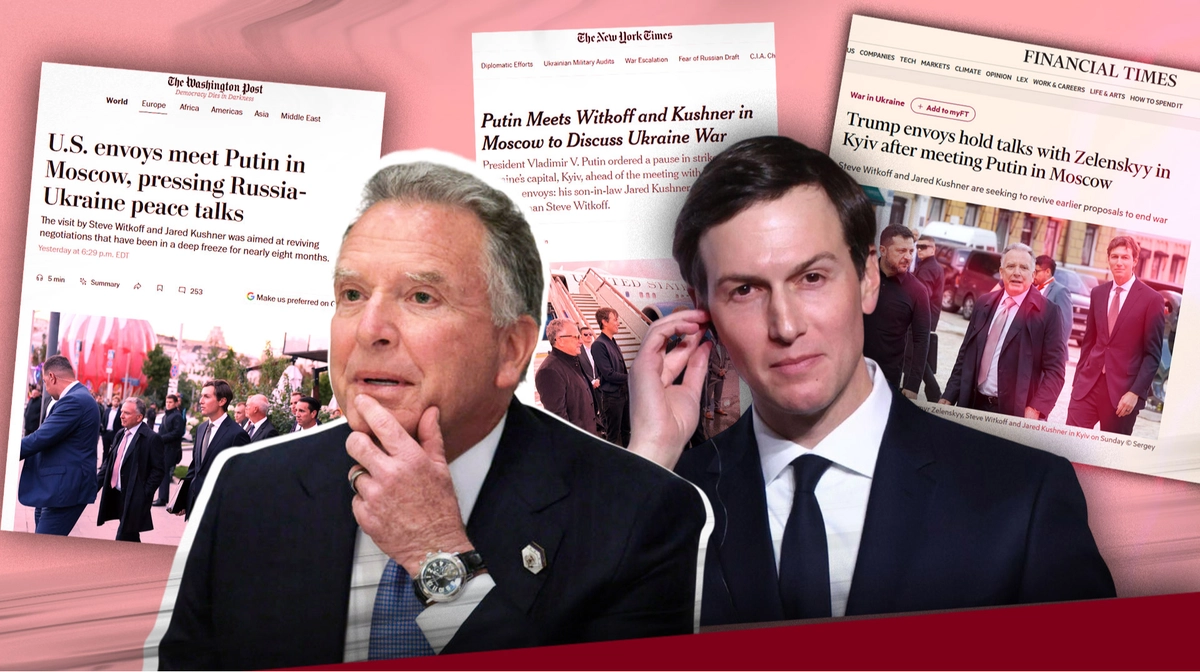
Ukraine’s response to the same American overextension is considerably harsher. In Kyiv, the arrival of Steve Witkoff and Jared Kushner on September 6 was seen as an important symbol: for the first time, key Trump representatives had traveled not only to Moscow but also to Ukraine. Kyiv considers the inclusion of representatives from Britain, France and Germany in the third round of contacts a useful outcome. According to the Ukrainian logic, Europe should not merely be the party that later pays the consequences of an American-Russian agreement. But there is almost no optimism. In an analysis by Ukrainska Pravda, Vladislav Faraponov, head of the Institute of American Studies, assesses the impact of the visit as limited: in his view, the Kremlin’s position has not changed, and for the war to truly become a priority, it is necessary to speak directly with Trump, not only with his envoys.
This Ukrainian wariness is not based on opposition to negotiations as such. Kyiv is ready for a trilateral format with the United States and Russia, which Kushner spoke about reviving. But in the Ukrainian interpretation, negotiations are valuable only when they are backed by coercion aimed at forcing Russia to make concessions. Otherwise, the “many new ideas” mentioned by the American envoys after their meetings risk becoming a new name for the old deadlock. Ukrainian commentators are especially sensitive to the asymmetry of the contacts: before the current trip, Witkoff had already visited Moscow several times, while Kyiv had long been bypassed by the American team. This gives rise to fears that American diplomacy views the war primarily as a problem to be removed from the agenda, rather than as aggression whose consequences must be addressed.
This is where the Ukrainian and Japanese perspectives intersect. For Ukraine, a dangerous deal is one that rewards force and leaves Russia able to recover for another war. For Japan, the same principle is tied to a much broader question: is it acceptable for a great power to cement changes to borders or spheres of influence achieved through military pressure? Japanese experts have long drawn parallels between Ukraine and East Asia. A strategic review by the Japan Institute of International Affairs explicitly stressed that Tokyo has an interest in ensuring that a peace agreement does not undermine Ukraine’s territorial sovereignty. For Japanese audiences, this is not abstract solidarity but a lesson for their own security environment.
Turkey, by contrast, sees not only a risk in these negotiations but also a vacancy. Official Ankara continues to speak of the need to revive direct Russian-Ukrainian dialogue. On September 1, Turkey’s representative to the UN, Ahmet Yıldız, said that resuming the negotiation process was “vital,” while once again confirming Turkey’s non-recognition of the annexation of Crimea and its support for Ukraine’s territorial integrity, as Anadolu reported. But the practical Turkish meaning of this position lies elsewhere: if American mediation stalls because of Iran, domestic politics and global rivalry with China, Istanbul may once again become a working venue where Moscow and Kyiv are at least able to talk to each other.
The most unexpected common feature of these three reactions is not anti-Americanism but doubts about the reliability of American consistency. Ukraine still considers the United States an indispensable source of pressure on Russia and military support. Japan needs its alliance with America as the foundation of its defense. Turkey seeks to improve relations with Washington, including on sanctions and the defense industry. Yet in all three countries, Trump’s America is seen as a power whose priorities can change sharply: Ukraine today, Iran tomorrow, and domestic inflation or an election agenda the day after that.
That is why local discussions converge on a single conclusion. The United States is now judged not by the force of its statements or the number of envoys’ visits, but by whether it can simultaneously prevent the Strait of Hormuz from triggering a new energy panic, avoid turning peace in Ukraine into a pause before the next war, and preserve the trust of its allies. For Japan, this is a test of international law; for Turkey, a test of its growing role as a mediator; and for Ukraine, a test of whether Washington is prepared to pay the political price for a peace that will be not merely quick, but lasting.