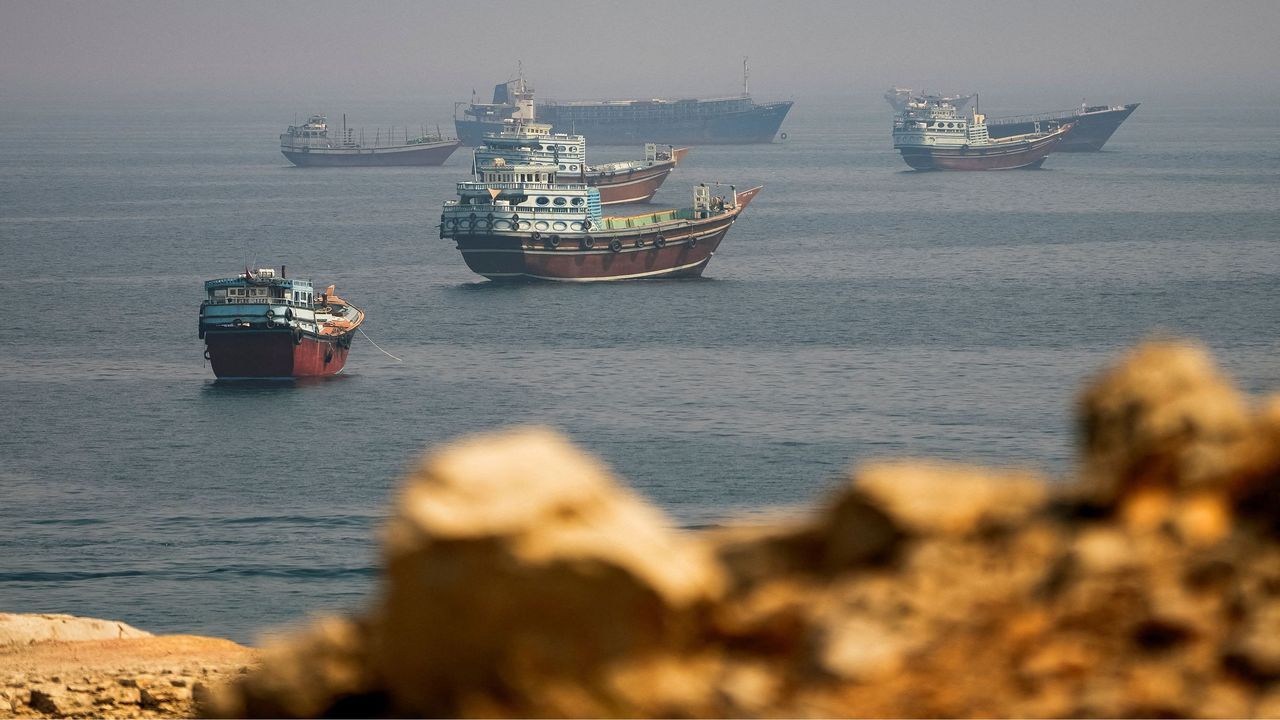
By September 9, 2026, the main American story prompting strong reactions in Japan, Brazil and Israel was not another domestic political drama in Washington, but the United States’ prolonged confrontation with Iran. A new round of exchanges around the Strait of Hormuz pushed Brent crude above $100 a barrel for the first time since May. Yet the three countries interpret the story in entirely different ways: in Japan, as a test of energy security and America’s ability to contain China at the same time; in Brazil, as an imported inflationary shock and an example of how U.S. geopolitics is reshaping the oil market; and in Israel, as a painful reminder that even its closest ally may pursue its own vision of how the war should end—one that does not necessarily coincide with Israel’s. As Brazil’s Folha de S.Paulo reported, Brent rose to $100.95 on September 9 amid U.S. strikes on Iranian tankers and retaliatory Iranian attacks on vessels and facilities belonging to U.S. allies. (www1.folha.uol.com.br)
The Japanese debate is particularly revealing because the American operation is viewed there as more than a Middle Eastern war. For Tokyo, Hormuz is an artery linking the conflict to the country’s everyday economy: about 90% of Japan’s oil imports come from the Middle East. In his Nikkei Book Plus column, energy analyst Noriaki Oba suggests viewing current events not as a brief market flare-up, but as the return of the structural vulnerability seen during the 1973 oil crisis. His central point is that reserves and alternative routes are indeed better than they were half a century ago, but Japan’s dependence on the region has not fundamentally disappeared. (bookplus.nikkei.com)
Even more troubling for Japanese commentators is the strategic impact. An analysis by nippon.com says that the prolonged redeployment of U.S. aircraft carriers and air-defense resources to the Middle East could weaken deterrence in the Indo-Pacific, particularly in the event of a crisis around Taiwan. Japan’s reaction, therefore, is not limited to fears of expensive gasoline: in seeking to force concessions from Tehran, Washington may inadvertently reduce the credibility of its guarantees in areas where Japan considers them vital. The authors also note broader distrust of the style of U.S. leadership: a Pew international survey they cite found that, across 36 countries, 76% of respondents distrust Donald Trump’s international leadership. (nippon.com)
In Brazil, the American war is viewed above all through the price of money. The rise in oil prices is a mixed signal. It may appear favorable for the oil sector and export revenues, but for households, importers and the Central Bank, it poses the risk of a new wave of inflation. In a CNN Brasil article, Sincra Chief Investment Officer Gustavo Cruz links pressure on U.S. prices to the war, while Mirae Asset Chief Economist Marianne Costa explains that rising U.S. bond yields are immediately transmitted to emerging markets, including Brazil. In other words, the local concern is this: the United States is waging a war far from South America, but Brazilian companies and consumers may pay through higher borrowing costs and a weaker currency. (cnnbrasil.com.br)
Brazilian perceptions of the United States are also shaped by the Venezuelan angle. In Latin America, Washington’s agreement granting it access to Venezuela’s oil fields is seen less as a technical measure to stabilize supply than as an attempt by the United States to gain political control over a neighbor’s strategic resource. Even in Folha’s account, experts emphasize that a significant increase in production would require years and enormous investment, while the structure of the deal itself is already fueling talk of “neocolonialism” in Venezuela. For Brazilian audiences, this adds an important qualification to the American argument about protecting the global energy market: Washington is simultaneously fighting for freedom of navigation in Hormuz and building an exclusive oil mechanism in the Western Hemisphere. (www1.folha.uol.com.br)
Israel’s reaction to the same war is the most paradoxical. One might expect American pressure on Iran to be viewed as an unconditional benefit. Yet in Israel, the demand for toughness toward Tehran is growing alongside doubts that the American strategy is actually making the country safer. The Israeli newspaper Israel Hayom described the U.S. economic war against Iran as a “calculated but dangerous gamble”: according to the paper, the blockade and strikes have not forced Tehran to accept Washington’s terms, but have instead given it time to rebuild its missile, drone and potentially nuclear capabilities. (israelhayom.co.il)
These concerns are supported by more than editorial tone. A June poll by the Israel Institute for National Security Studies—INSS—found that 66% of Israelis consider the U.S.-Iran memorandum bad for Israel; only 12% believe Trump is “very committed” to protecting Israeli interests. Even more revealing is the distribution of views on the war: 37% see Iran as the winner, 43% say there is no winner, and only 15% name Israel as the winner. (inss.org.il)
This is the main conclusion emerging from the Japanese, Brazilian and Israeli reactions. None of them considers the United States a weak power: American military, financial and sanctions power remains a decisive factor. But local observers increasingly question whether that power is being converted into a predictable political outcome. Japan fears that America is dissipating its strategic attention; Brazil fears that it is exporting inflation and politicizing energy; Israel fears that the American campaign could end in a deal leaving Iran room to rebuild. This is no longer familiar anti-Americanism, nor a simple expectation of American leadership. It is a more sober and uncomfortable view: Washington’s decisions have become so global in their effects that allies and partners are judging the United States primarily by the price they themselves will have to pay for American strategy.