In discussions in China, Brazil and Ukraine over the past few days, the United States has emerged not merely as a great power, but as a generator of changes to which others must urgently adapt. The issues differ: in Beijing, US tariffs and restrictions in artificial intelligence are especially prominent; in Brazil, a new phase of the tariff conflict over exports and the Pix instant-payment system; and in Ukraine, the Donald Trump administration’s attempt to revive negotiations with Moscow. But the underlying concern is the same: local commentators increasingly see Washington as a partner whose rules, promises and tools of pressure may change faster than negotiations can be completed.
The broadest common theme is the transformation of US trade policy into an instrument of political coercion. Chinese authors describe this as the White House’s almost continuous search for new legal grounds to pursue its longstanding goal: maintaining high barriers even when existing mechanisms run up against judicial or political constraints. In an analysis by Xinhua, this logic is expressed in exceptionally stark terms: the rules and legal provisions change, but the “unilateral” nature of the policy does not. Beijing sees this not as an ordinary dispute over the trade balance, but as Washington’s attempt to establish the right to determine unilaterally who may participate in global trade and on what terms. New US measures against Canada, announced on September 8, have only reinforced this picture: bans on some Canadian imports and 50 percent tariffs on additional categories of goods are viewed in the Chinese press as proof that even America’s closest allies are coming under attack. (news.cn)
Brazil’s reaction is much more practical, but it reflects the same concern about sovereignty. After the United States imposed additional tariffs of 25 percent on some Brazilian imports, negotiations resumed. However, US complaints concerned not only goods but also Brazil’s domestic institutions—including Pix, the national instant-payment system—and access to the ethanol market. In an Agência Brasil report, the dispute is described as a conflict in which a US trade procedure is being used to assess Brazil’s domestic policies. (agenciabrasil.ebc.com.br) This is particularly sensitive for Brasília: Pix is not merely a fintech service, but a symbol of the state’s ability to build its own digital infrastructure without relying on US payment giants. As a result, the local debate is not limited to how much exporters may lose; it raises the question of whether the country can pursue an independent industrial and digital policy without risking tariff penalties.
At the same time, Brazilian analysts are not advocating a romantic break with the United States. Their conclusion is rather that vulnerability must be reduced. CNN Brasil economic commentator Débora Oliveira notes in an analysis marking the anniversary of the first “tarifaço” that over the past year Brazil has become less dependent on the US market. (cnnbrasil.com.br) This point matters more than the statistics: in Brazil’s reading, US pressure not only creates losses but also accelerates the search for other markets, agreements and supply chains. Gustavo Pessoa, an economist at the Getulio Vargas Foundation, notes in a comment for TMC that the tariff is formally paid by the US importer, although the indirect damage also affects Brazilian producers. His forecast is sober: the tariffs are likely to remain, and Brazil will have to continue technical negotiations with Washington. (tmc.com.br) In other words, Brazil’s strategy is neither capitulation nor a trade war for the sake of making a gesture, but diversification while keeping the negotiating channel open.
In the Chinese view, the same pattern extends to technology. US statements alleging that Chinese companies are copying American AI models on an “industrial scale” prompted an official protest from Beijing. A representative of China’s Ministry of Commerce called the allegations unfounded and saw them as evidence of the United States’ desire to monopolize computing power. Chinese experts in Global Times describe this approach as the politicization and “weaponization” of technological rules. (globaltimes.cn) The specifically Chinese aspect here is that tariffs and technology bans are viewed as parts of a single system: one restricts access to markets, while the other restricts access to knowledge, chips and AI infrastructure. In this narrative, Washington is no longer protecting individual industries but attempting to address a strategic task—to slow the emergence of a competitor capable of acting autonomously in critical technologies.
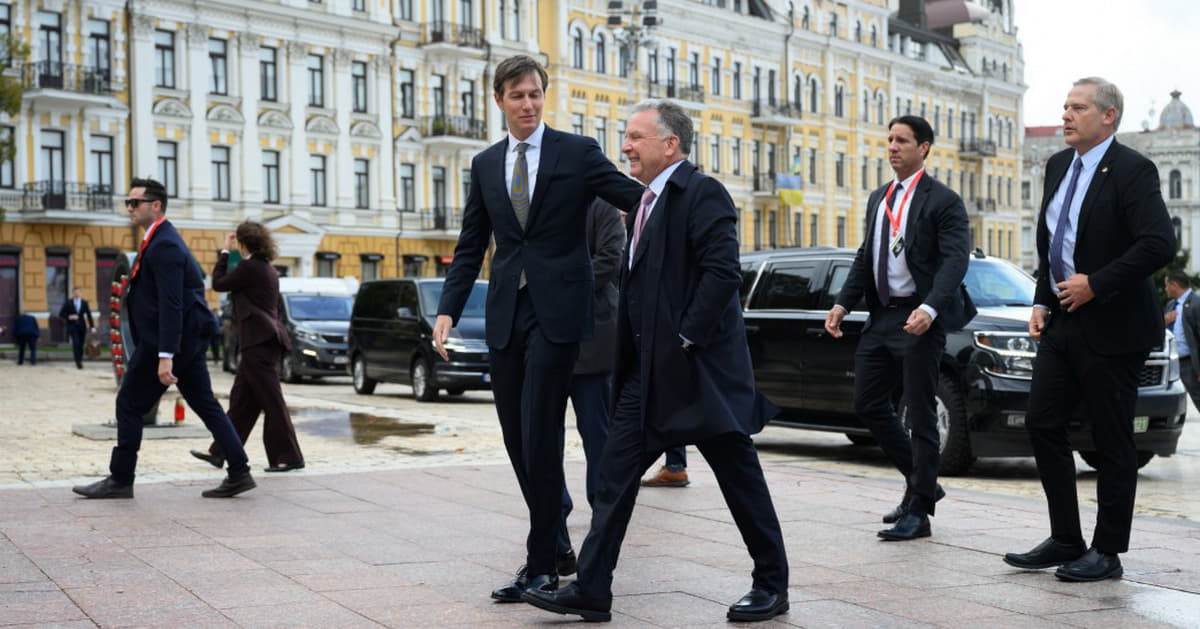
Ukraine’s perspective on the United States is entirely different in terms of what is at stake, but similar in its attitude toward the unpredictability of US policy. Following Steve Witkoff and Jared Kushner’s visit to Kyiv on September 6, and then Trump’s telephone conversation with Vladimir Putin on September 8, Ukrainian media have focused less on the diplomatic activity itself than on its substance and guarantees. European Pravda writes that Kyiv sees value in returning to a trilateral US–Ukraine–Russia format, but harbors no illusions about the war ending soon. (eurointegration.com.ua) The main Ukrainian point can be expressed almost as a formula: negotiations make sense only when they strengthen, rather than replace, defense. That is why discussions of a possible ceasefire are constantly accompanied by questions about air-defense supplies, Patriot systems, security guarantees and support ahead of winter.
Ukraine’s wariness of the very idea of a “breakthrough” is especially characteristic. In a comment for NV, Ihor Chalenko, head of the Center for Analysis and Strategy, asks not whether a new American plan can bring peace closer in general, but whether it can bring peace closer on terms acceptable to Ukraine. (podcasts.nv.ua) This is a fundamental distinction. For the US administration, an interim diplomatic success may have value in its own right; for Kyiv, an end to the fighting without effective guarantees and without pressure on Moscow could prove merely a pause beneficial to Russia. Ukrainian authors therefore interpret Trump’s contacts with Putin not as an automatically positive signal, but as a test: is Washington prepared to combine its desire for a quick agreement with real pressure on Russia and the strengthening of Ukraine’s position?
The most unexpected common conclusion from these three national debates is that criticism of the United States does not necessarily amount to anti-Americanism. China uses US tariffs and technology measures to argue for technological self-reliance; Brazil uses them to defend economic and digital sovereignty; and Ukraine uses them to demand that US diplomacy remain grounded in the military and political reality of the war. All three reactions converge on one point: the era when an American initiative was considered, in itself, a sufficient guarantee of an outcome is over. Now, in Beijing, Brasília and Kyiv, people assess not Washington’s intentions but the cost of its decisions, the durability of its commitments and what tools other countries retain if the US course changes again.