Boeing is offering engineers an improved contract to avoid a strike, while Seattle businesses complain about slow police response and a police operation involving arrests takes place in Crown Hill.
Boeing offers engineers a 10 percent raise to avoid a Washington strike
Boeing has made its unionized engineers and technical workers, represented by SPEEA, a final contract offer intended to prevent a large-scale strike. The group includes more than 16,000 employees, concentrated mainly in the Puget Sound region, as well as in Oregon, California, and Utah. These are the first full negotiations between Boeing and SPEEA in 14 years, and their outcome could significantly affect both the aircraft manufacturer and the broader high-tech and engineering labor market.
The offer, presented Friday, provides for an immediate 10 percent pay increase once the contract is approved, another guaranteed 4 percent increase in March 2027, and a guaranteed minimum annual increase of 4 percent through 2030. In addition, “salary pools” of 6 percent are planned for 2028, 2029, and 2030. At least 4 percent of each pool would be guaranteed, while the remainder could be distributed depending on the outcome of negotiations and the needs of individual divisions. The contract also revises language concerning remote work and overtime restrictions for certain categories of employees.
The union leadership, which represents more than 12,600 engineers and scientists as well as nearly 4,000 technical workers, recommends that members vote yes. In a joint statement, the SPEEA negotiating committee emphasized that these results were made possible by the unity and solidarity shown in recent weeks. The union called the proposal “a real step forward toward improving pay and working conditions, as well as rebuilding the relationship between Boeing management and union members.” An official ratification vote date has not yet been announced; the union will set it.
On the company’s side, Boeing Vice President and Chief Engineer of Manufacturing Design Ben Nimmergut said the final offer addresses the key priorities of employees and SPEEA’s negotiating teams, including an immediate pay increase and larger guaranteed salary pools. “We are optimistic that this will allow all of us to focus on the important work ahead,” he said, according to FOX 13 Seattle.
The context of the negotiations makes the situation especially tense. The current labor agreement between Boeing and SPEEA, last extended in 2020, expires October 6. On August 21, engineers and technical workers rejected the company’s previous offer and overwhelmingly authorized a possible strike: about 64 percent of members voted against the contract, demanding more substantial improvements, while nearly 88 percent voted in favor of a strike. Experts offered mixed assessments of that rejection. Mike Dunlop, who has 40 years of experience working directly and indirectly with Boeing, said the company’s new leadership appeared willing to compromise, but that a strike would ultimately benefit no one. “This is the wrong time for industrial action, when Boeing has an order book representing nearly eight years of production, including increased output and the opening of a new 737 line,” he said. Nevertheless, the threat of a strike appears to have prompted the company to offer more generous terms than in the previous round.
If accepted, the proposal will send an important signal throughout the sector. Boeing, still dealing with the effects of the pandemic and production problems, is trying to stabilize relations with the key engineering personnel on whom the safety and timely delivery of aircraft depend. If the contract is rejected and a strike begins, the company could face further delivery delays and rising costs. Amid fierce competition with Airbus and a growing order book, that could prove extremely painful. For now, the union and Boeing management are at a point where a single vote will determine whether they compromise or enter into an open labor confrontation.
Even Nordstrom complains: Seattle police are not responding to calls
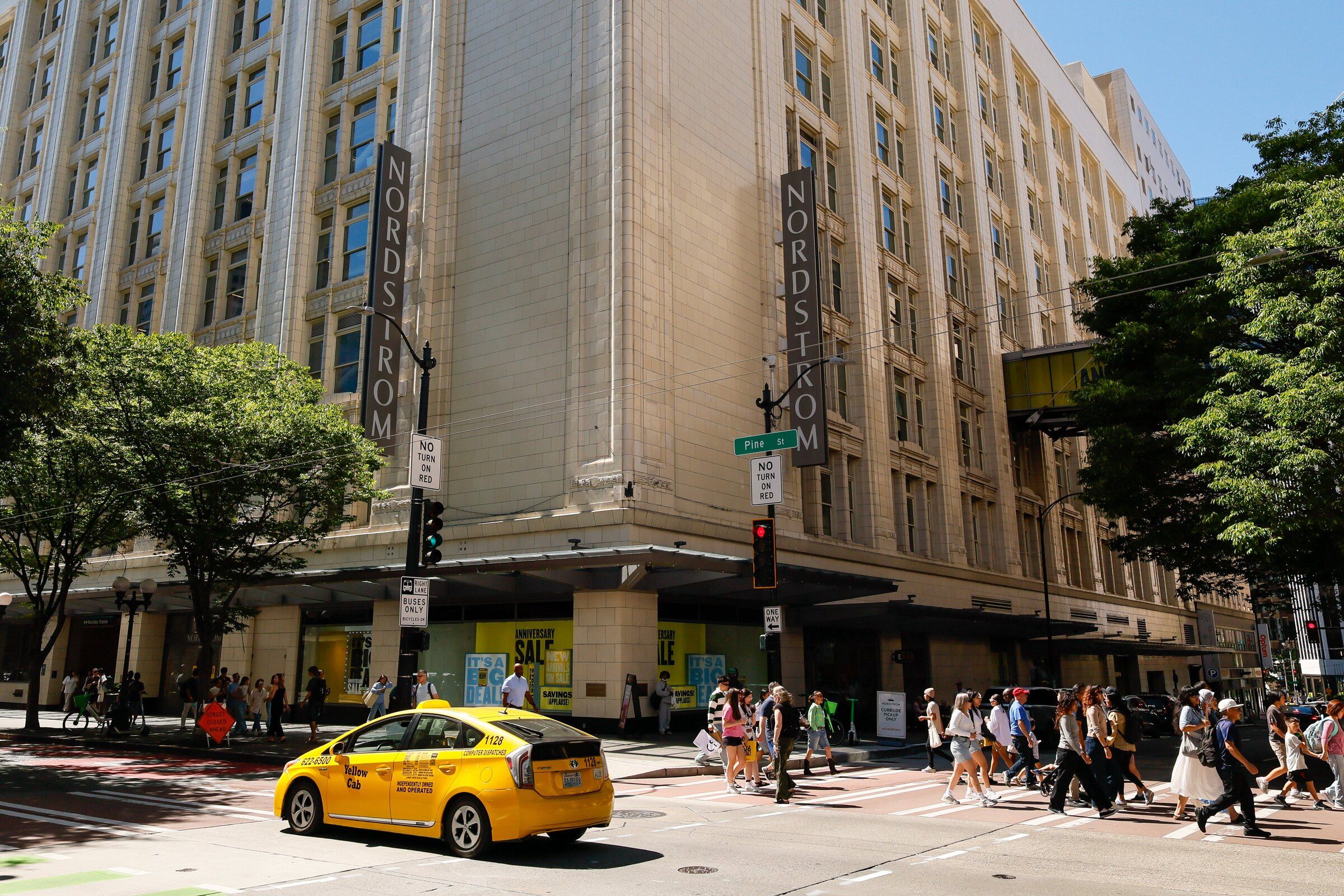
Seattle has long faced a problem residents have discussed for years: when you call 911, police often simply do not show up. The issue has been reported repeatedly, but major corporations are now saying the same thing. Last week, 35 executives from leading companies — including Microsoft, Costco, and Alaska Airlines — appealed to city officials to improve public safety. Among the signatories was Nordstrom CEO Erik Nordstrom, who cited startling statistics: at the company’s flagship store in downtown Seattle, only 29 percent of 911 calls result in a police response. By comparison, at the Southcenter mall in the suburb of Tukwila, the figure is 100 percent. The downtown store made 70 calls between January and July of this year, and only 20 resulted in a police visit. In Southcenter, officers responded to all 47 calls. Meanwhile, Tukwila’s police budget is about $22 million, compared with $488 million for Seattle’s police department. The disparity has left businesses and residents baffled.
The problem is not that Seattle police are inactive in every situation. On Thursday morning, for example, officers arrived within minutes at a fight in Westlake Park, near the Nordstrom store, and arrested a murder suspect at the scene. But such cases are more the exception than the rule. According to analyst Jeff Asher of AH Datalytics, Seattle ranks last among 14 major U.S. cities for response times. In New York, police arrive twice as fast on average. Seattle’s target for the most serious calls, Priority 1, is seven minutes or less; for calls involving a threat of violence or property damage, Priority 2, the target is 15 minutes. In practice, however, the average response time this year is 9.6 minutes for Priority 1 calls, with a median of seven minutes — meaning half met the standard and half did not — while Priority 2 calls take a full 56 minutes on average. That is better than several years ago, when staffing shortages forced the department to stop responding to some lower-priority calls altogether. But it is still far from ideal.
The reason is a staffing shortage. Despite recent recruitment efforts, the Seattle Police Department has shrunk by 25 percent over six years. In 2020, there were 694 patrol officers; now there are 489. The total number of employees has fallen from 1,339 to 985, according to a June report to the City Council. At the same time, the police budget has increased by roughly 20 percent, from $409 million to $488 million, reflecting higher salaries and other costs. This situation is common among local governments, much like Seattle schools, which speak of “bankruptcy” despite record revenues. The paradox is that crime in the city is generally declining, with serious offenses down year over year despite high-profile shootings. This has led some to argue that police refusal to respond to property crimes is not such a major problem. But the author asks: What if the perpetrator is still at the scene? Or what if the issue is illegal street racing that could be dispersed by a couple of patrol cars? In the author’s view, Seattle has simply “lowered the bar” because failing to meet standards has become normal. Possible solutions include hiring civilian investigators for property crimes, using AI agents, or submitting evidence through an online portal instead of making pointless 911 calls. But falling behind Tukwila, where police respond to every call, seems unacceptable. In their letter to city officials, business leaders ask the city to “return to the current seven-minute response standard for Priority 1 calls” and “redirect spending and resources toward achieving it.” Fulfilling that request will be difficult, however, given the scale of the staffing crisis and the system’s inertia.
For context, Priority 1 calls involve threats to life, such as fights involving weapons or murders. Priority 2 calls involve threats of violence or property damage but no immediate danger to life. “Defund the police” is a movement advocating reduced police funding that gained strength after George Floyd’s murder in 2020, leading many officers to leave the profession. The term “defining deviancy down” was coined by Sen. Daniel Patrick Moynihan to describe a process in which society stops treating a problem as a problem because it has become too widespread. According to the author, that is precisely what is happening with police response times in Seattle.
Police standoff in a quiet Seattle neighborhood: three detained and questions unanswered
Last Friday afternoon, residents of Seattle’s Crown Hill neighborhood, known for its quiet streets and family homes, witnessed a scene more reminiscent of a crime drama: police vehicles, blocked roads, and a battering ram breaking through a front door. According to Fox 13 Seattle, the incident began when a man wanted on multiple warrants fled into a home near the intersection of Northwest 90th Street and 14th Avenue.
According to official information, officers attempted to arrest the suspect at about 2:30 p.m., but he fled into the residence. This began an almost hourlong standoff. Officers first cordoned off the block and urged residents to avoid the area, then used a battering ram to enter the house. By the time they went inside, the man had been taken into custody, while two other people inside were detained. Police later said the scene had been cleared and the threat to the public had ended.
Yet behind the apparent clarity of the official reports lies a series of unanswered questions. The most important is what exactly the main suspect was wanted for. Police referred to “multiple warrants” but did not specify the nature or seriousness of the allegations. Were they minor offenses, such as unpaid fines, or something far more serious that would explain such an aggressive arrest operation? The fate of the other two detainees is equally unclear. Were they arrested as a result of the incident, or merely held temporarily while officers investigated? Official statements do not answer that question.
The use of a battering ram is notable in itself. Such a tool is used when there is reason to believe a suspect will not open the door voluntarily, and it indicates that police assessed the risk as elevated. Yet the report says nothing about whether weapons were used during the arrest, whether anyone was injured, or whether anyone threatened police. That leaves room for interpretation, ranging from a standard warrant operation to a potentially more troubling context that law enforcement chose not to disclose.
The local context is also worth noting. Fox 13 Seattle’s report appeared alongside other regional crime stories, from a fatal shooting in Belltown to an attack on police officers involving a stolen truck in Everett. This is not accidental: media outlets place the Crown Hill incident within a broader frame, suggesting that even Seattle’s more affluent neighborhoods are not immune to bursts of violence and police operations. For local residents, it may prompt a reassessment of their assumptions about the safety of their own neighborhood.
So what do we know? We know that arrests were made, force was used, and details were withheld. Police did their job: a wanted suspect was taken into custody and the scene was cleared. But without answers about who these people were and what exactly happened behind the closed door, the story remains incomplete, and it is too early to draw conclusions. Further official statements may shed light on the circumstances, but for now we know only as much as police deemed necessary to report — and that may be the main lesson of the day for anyone following news from Seattle.