
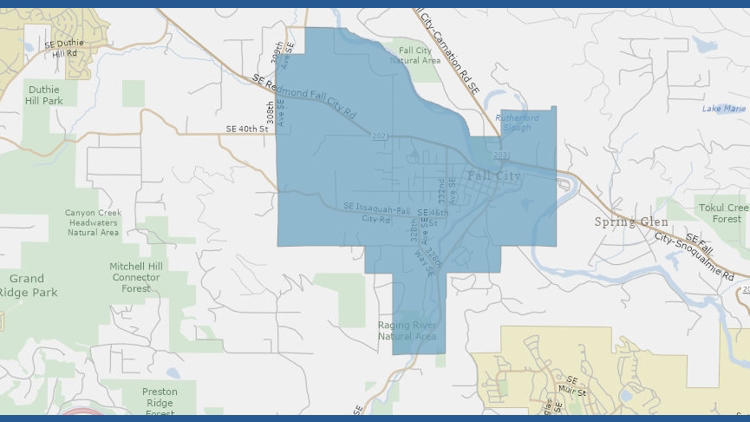
Residents of Fall City in eastern King County have been advised not to drink tap water unless it has been boiled, after tests detected coliform bacteria. The advisory, issued on October 29, was still in effect as of November 2. It covers the town center, sections of the Fall City–Redmond and Fall City–Preston roads, and David Powell Road. Drinking fountains at schools have been turned off, students are being given bottled water, and families are being asked, if possible, to send students with their own supply from a safe source.
For a small community where water is usually an unnoticed part of daily life, the order quickly disrupted familiar routines. Until the advisory is lifted, tap water must not be used for drinking, cooking, brushing teeth, or making ice; bottled or boiled water is considered safe. The state Department of Health advises bringing water to a rolling boil and boiling it for at least one minute, then letting it cool.
Coliform bacteria do not necessarily cause illness on their own. But their detection is an important warning sign: contamination may have entered the system, potentially along with disease-causing microorganisms. That is why the state has added Fall City Water District to its list of active boil-water advisories, even though the information released does not report confirmed E. coli or identify a specific cause.
The water district must now collect follow-up samples and inspect the system to determine whether the positive result was isolated or points to a problem in the distribution pipes or water source. When contamination is confirmed, standard response measures include tracing its source, flushing the system, making repairs if needed, and often temporarily chlorinating the water. The advisory will be lifted only after tests show that the water once again meets safety standards.
Fall City Water District is a small municipal water district established in 1981 and overseen by three elected commissioners. It serves approximately 1,120 connections and about 3,100 people in an area south of the Snoqualmie River. Its water comes from groundwater sources: the district operates a main intake near its office and five separate wells, including one on the grounds of Chief Kanim Middle School.
That detail makes the precautions at the schools especially noteworthy. Fall City Elementary School and Chief Kanim Middle School remain open as usual, but have switched to emergency procedures for meals and water access: drinking fountains are off, bottled water is being provided to students, and cafeteria operations have been adjusted to avoid using potentially unsafe water to prepare and serve food. The supply of bottled water is limited, so the request to families is not a formality but a practical appeal.
State rules for food-service establishments in such cases require them to shut down equipment connected to drinking water, including ice machines and fountains, and to use only boiled or bottled water for cooking. Menus may be reduced, and some routine procedures may be replaced with disposable dishes or more intensive sanitation. The fact that schools have not closed means they are trying to meet these requirements while keeping the school day going for children and maintaining a familiar routine for parents.
Until the district identifies the source of the bacteria and announces when the advisory will be lifted, residents should follow a simple rule: tap water is suitable for household uses, but should not be consumed without first being boiled. Families with young children, older adults, and people with weakened immune systems should be especially cautious. In a town where the network of pipes and wells is usually taken for granted as reliable, several positive test results have served as a reminder of how fragile that confidence can be.



Based on: Fall City residents and 2 schools urged to boil water