In Seattle, progressive activist Nilu Jenks has scored a landslide victory in a City Council election, winning by seventeen percentage points and shifting the balance of power ahead of next year’s election, when all seven district seats will be up for grabs. Meanwhile, western Washington is bracing for a series of Pacific storms bringing winds of up to 50 mph, heavy rain and waves about six meters high. In sports, the Seattle Sounders are risking it all in the final round of the MLS season against Los Angeles FC, which has already secured sixth place in the West.
Nilu Jenks Scores a Landslide Victory in Seattle City Council Election
Progressive activist Nilu Jenks won the special election for Seattle City Council District 5, leading her opponent by a decisive seventeen percentage points on election night. The victory not only shifts the balance of power in the city legislature, but also sends a warning to the council’s centrist wing ahead of next year’s general election, when all seven district seats will be up for reelection.
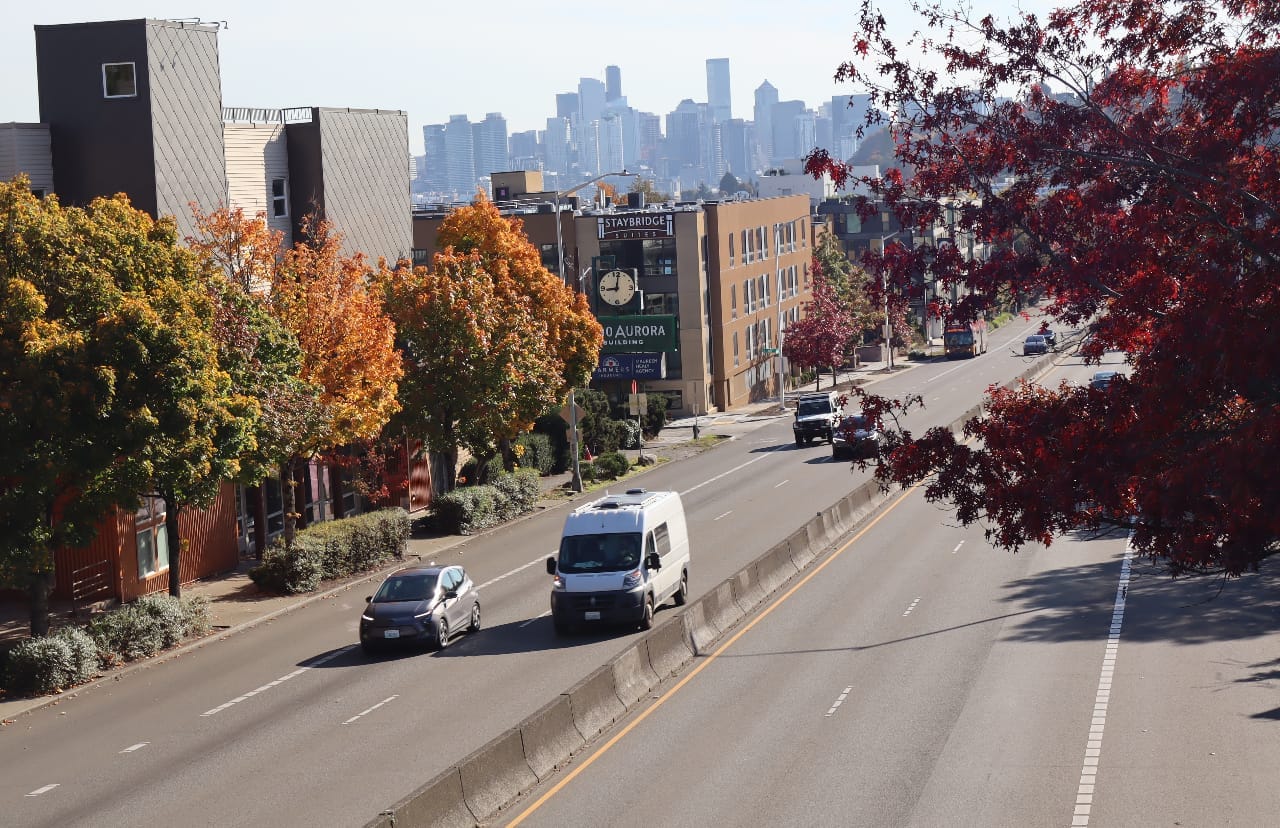
Jenks, who headed the nonprofit FairVote Washington, which campaigned to introduce ranked-choice voting in Seattle municipal elections, won against Julie Kang, an educator and former bank chair backed by centrist leaders. Her supporters included Councilmembers Bob Kettle and Maritza Rivera, as well as former Councilmembers Sara Nelson and Tim Burgess, who also donated to a political committee supporting Kang. Current Council President Joy Hollingsworth endorsed both candidates. The difference in their approaches was also evident in their views on public safety: while Kang and her allies favored tough measures, Jenks supports expanding Community Assisted Response and Engagement, or CARE, which dispatches mental-health professionals and social workers instead of police to certain calls. Speaking to The Urbanist shortly after her victory, Jenks named safe redesign projects on Aurora Avenue and Lake City Way, expanding CARE, addressing “food deserts” and subsidies for heat pumps as her priorities. She said the state has already allocated a $50 million grant for Aurora, but lawmakers, including Seattle Representative Julia Reed, are losing patience over the project’s slow progress toward being ready for construction. “I would really love to get the money allocated for Aurora moving and actually get more funding, so Aurora can become a place everyone can enjoy — cyclists and pedestrians alike — with good dedicated bus lanes, but also so people can visit the businesses along it that deserve our support,” she said. “I also want to secure similar funding for Lake City Way. That’s another place where a lot of people are suffering, and, you know, it’s not safe for pedestrians.”
Jenks’s victory expands the progressive bloc on the council to four members, while the remaining five sometimes form a centrist coalition, though Dan Strauss of District 6 and Rob Saka of District 1 occasionally vote with progressives. District 5’s shift from centrist to progressive will make it easier for Mayor Katie Wilson to advance her legislative agenda. It will also mean the departure of interim Councilmember Deborah Juarez, one of the mayor’s sharpest critics, particularly on public-safety issues. Jenks will take office as soon as the election results are certified later this month, rather than in January, but will face reelection again next year. Her victory was made possible in part by Katie Moore’s decision to resign before the end of her term, triggering a special election in an even-numbered year.
In her speech at a gathering of supporters in north Seattle, Jenks framed her victory as part of a broader struggle against Trumpism, to restore trust in American institutions and to bring down the cost of living. “As the daughter of Iranian immigrants, I know that democracy is not something we can take for granted,” she said. “I grew up watching my parents lose their country, and as an Iranian American, I see the threat of ever-looming war hanging over the country my family comes from, while families here at home face fear, uncertainty and rising prices. Trump’s war with Iran has cost billions of dollars, and rising fuel prices are putting even more pressure on family budgets.” With Democrats winning the Senate and House of Representatives in what the article calls a “blue wave,” pressure to end the war with Iran will grow — and Jenks explicitly ties the local agenda to this national framework.
Food security was another campaign issue, made more urgent after grocery chain Kroger announced it would close its Fred Meyer store in Lake City, a key resource for much of the local community. In her speech, Jenks listed the people she said her campaign represents: someone who cannot afford a car or exorbitantly expensive gas and relies on public transit and protected bike lanes; an immigrant family and a young transgender person who want what everyone wants — to feel safe, loved and free to be themselves; an older person on a fixed income wondering whether they can stay in the city they helped build as rents, housing costs and property taxes rise; a small-business owner who has invested everything in their business and wants a safe, thriving neighborhood; and a parent who wants their child to get home safely. She stressed that the city must respond to public-safety concerns “both urgently and compassionately.”
At the end of her speech, Jenks summed up what could be considered the credo of her campaign: “This moment is asking us not to stop being afraid, but to refuse to let fear decide who we become. Across the country, Trump and his allies are telling us that our cities are broken, that the answer is more fear, more division and more repression. But Seattle is choosing a different path… When we can’t build housing, fix a sidewalk or make a bus stop safe, we make the case for those who say our cities don’t work. So let’s prove them wrong by making this city work for all of us.” A few of the concepts mentioned in the article warrant explanation. Ranked-choice voting, which Jenks’s organization campaigned for, allows voters to rank candidates in order of preference rather than choose just one; it will take effect in Seattle municipal elections next year. CARE is a civilian, non-police response service for calls involving mental-health and social issues, and Jenks contrasts expanding its staff with a law-enforcement approach. A “food desert” is an area where residents lack access to an affordable supermarket selling fresh food, making the closure of the Lake City Fred Meyer a social as well as a commercial issue. The utility-bill financing Jenks supports for heat pumps is a mechanism through which the cost of installing energy-efficient equipment is repaid gradually through monthly bills, lowering the upfront barrier for lower-income households. Finally, “blue wave” is a common term for a decisive Democratic Party victory; blue is the party’s color in American politics.
The key takeaway is that Seattle has not merely gained another progressive councilmember: the balance of power has shifted, making it easier for Mayor Katie Wilson to advance her initiatives and weakening the centrist coalition ahead of next year’s election for all seven district seats. The seventeen-point margin, which is expected to grow as late-counted ballots in Seattle tend to lean progressive, reads as a warning to centrists: the support of figures such as Kettle, Rivera, Nelson and Burgess was not enough to save their candidate. Jenks’s priorities — speeding up the Aurora redesign with its $50 million in funding, securing similar funding for Lake City Way, expanding CARE, addressing food deserts and subsidizing heat pumps — align with “urbanist” priorities such as quality transit, connected sidewalks and affordable housing. That helps explain why the publication endorsed her both in 2023 and this year. The Seattle Transit Measure, a measure to fund transit that was leading by a wide margin on election night, makes improvements to bus service much more feasible. Finally, Jenks’s rhetoric shows how local elections in the United States are increasingly tied to national and even foreign-policy debates: conversations about sidewalks…
Seattle Braces for Another Round of Storms: Winds Up to 50 mph, Heavy Rain and Waves as Tall as a Two-Story Building
Residents of western Washington are in for another spell of unsettled weather as a series of Pacific storms brings strong winds, rain and high waves to the coast. According to the FOX 13 Seattle forecast, the first front began affecting the weather overnight Wednesday into Thursday, and conditions will worsen over the weekend. Forecasters warn that the active storm pattern will continue into next week, so Seattle-area residents should not let their guard down just yet.
Here’s what is happening: a deep low-pressure system moving toward northern British Columbia is strengthening southerly winds over western Washington. The strongest gusts are expected along the coast and in the North Puget Sound area, north of Everett. A Wind Advisory has been issued there. Gusts could reach 40–50 mph (about 65–80 kilometers per hour) from overnight Thursday into Friday afternoon. Winds should gradually ease after that. Rain will initially affect the Olympic Peninsula and areas near the Canadian border, but as a cold front passes, precipitation will spread south and east, including into the Seattle metro area, where the start of the week was mostly dry.
Saturday will begin relatively calm and even warm, with daytime temperatures reaching the 60s Fahrenheit (about 15–20 degrees Celsius). But another deep low-pressure system will approach British Columbia on Saturday evening, bringing a new round of wind. The worst of the weather is expected overnight Saturday into Sunday: gusts around Puget Sound could reach 40–45 mph, while the coast and northern parts of western Washington will see even stronger winds. At the same time, a large ocean swell could reach the coast, with waves forecast to reach about 20 feet, or roughly six meters. This poses a serious threat to shipping and coastal areas.
A few terms in the forecast are worth explaining. A Wind Advisory is an official National Weather Service alert for potentially hazardous winds that can break branches, damage power lines and make driving difficult, especially for high-profile vehicles. A “deep low-pressure system” is an area of very low atmospheric pressure around which air masses move rapidly; the greater the pressure difference, the stronger the wind. Puget Sound is the region around the inlet of the same name in northwestern Washington, where Seattle is located. Finally, a “swell” is a series of long ocean waves generated by storms far offshore that later reach the coast, often creating dangerous surf.
Meteorologists say the current storm pattern is not about to let up. Next week, a whole “parade” of storms will cross the Pacific Northwest, bringing more rain to the lowlands, gusty winds and snow at higher elevations in the mountains. This is typical weather for fall and winter in the region, but the succession of systems makes it particularly notable. The main takeaways for residents: take precautions in advance by securing items in yards and on the street that could be blown away, prepare for possible power outages, and be mindful of the increased danger from high waves if heading outdoors or to the water this weekend. The strongest winds will come overnight, when most people are at home, lowering the risk to pedestrians and drivers but increasing the likelihood of infrastructure damage. Overall, the forecast signals that the fall and winter storm season is entering an active phase in Seattle, and it is too soon for residents to relax.
Decision Day at Lumen Field: Seattle Has Everything to Play for as LAFC Searches for Its Form Before the Playoffs
The final round of the MLS regular season is traditionally known as Decision Day, and in 2026 it brings together several storylines. For the Seattle Sounders, Saturday’s match against Los Angeles FC is a matter of survival in the playoff race: the team needs a win or a draw, along with favorable results elsewhere in the league. For Los Angeles, it is a chance to end a difficult stretch on a high note and head into the postseason with a clear mind, since sixth place in the West is already secured and the result will not affect its standing. In other words, the teams will meet with very different levels of desperation, although neither is in top form.
Los Angeles interim head coach Xavi Tamarit told reporters Thursday that he does not consider his opponent more motivated than his own team. He also noted that the match will be a major test for his side, with a full stadium and the pressure that comes with it. His comments were reported by the club. Tamarit took charge relatively recently, just five matches ago, and has been working to reshape the play of one of the league’s most talented squads. So far, his ideas have yet to fully take hold: last weekend, Los Angeles lost 3–1 at home to Minnesota, and the coach called the team’s passive opening fifteen minutes unacceptable for a club of its stature. He said the players and coaching staff were in complete agreement on the issue and that high standards must be maintained under all circumstances.
Seattle comes into the decisive match in an even more troubling state: the team has not won in almost a month and has no wins in its last five matches, with three losses and two draws, including a 5–1 defeat to conference leader Vancouver. For two established franchises that are usually among the top four in the West by the end of the regular season, this has been a difficult year, and Saturday will test not only their playoff ambitions but also their pride. It is telling that in May, when Los Angeles was also in poor form ahead of the break for the World Cup, Timothy Tillman came to the rescue, scoring the only goal in the 86th minute after a pass from Tyler Boyd, while backup goalkeeper Thomas Hasal made five saves. After the tournament, Los Angeles won three straight games by a combined score of 10–1 — a run the club would like to repeat.
The history between these two teams is full of memorable moments. Only the Galaxy have faced Los Angeles as often as Seattle has, and matches between these rivals rarely come without high stakes. In the club’s first-ever match, a Carlos Vela assist helped Los Angeles to a surprise 1–0 win at Lumen Field. Five years later, Los Angeles met Seattle four times in thirteen months across different playoff rounds: wins in the 2023 Western Conference Semifinals, the 2024 Leagues Cup quarterfinals and the 2024 U.S. Open Cup semifinals, but a loss in the Western Conference Semifinals that same year. Now another chapter will be added to the series.
Denis Bouanga, the club’s all-time leading scorer across all competitions, deserves special attention. He needs two more goals to become the first player in MLS history to score twenty or more goals in four consecutive seasons. Of his 126 goals for Los Angeles since joining in 2022, six have come against Seattle, making him the hosts’ biggest threat. Defensive midfielder Igor Jesus, who recently returned to the squad after a year of knee rehabilitation, said the team feels a responsibility to perform in this match, but its mentality has not changed: it wants to win and become champions. Tamarit also said that Tillman, who led the club’s midfielders in minutes played before a mid-August injury, will rejoin the team soon.
Los Angeles believes the key to victory lies in the opening minutes: if the visitors can control the ball, quiet the crowd and score first, they will gain a significant advantage. In 2026, the team has not lost in any competition when scoring first, recording seventeen wins, no losses and five draws, including twelve wins and five draws in MLS. But Tamarit is asking a deeper question: what kind of team do his players want to be when they are ahead — one that gives up possession and sits back, or one that goes looking for a second goal? And what kind of team do they want to be when trailing — one that looks for someone to blame, or one that pulls together in adversity? That, he said, is what matters most to the group and the club, and it is what they are working on. Seattle, for its part, will count on the urgency of the moment and the support of its devoted fans, who will be celebrating Fan Appreciation Day. The emotion at Lumen Field could prove decisive.
The winner of this match will gain not only points but also a psychological boost ahead of the playoffs. Since the first round of the postseason will be a best-of-three series and the tournament begins on November 19 with Wild Card matches, the teams will have a two-week break for international fixtures. Los Angeles’s first-round opponent will be determined on Saturday: it will be the third-place team in the West, one of Dallas, San Jose, St. Louis or Houston. Los Angeles will host the second game of the series at BMO Stadium over the weekend of November 27. For Seattle, Saturday may be its last chance to extend the season — and in that respect, the teams will take the field with very different stakes.
Explaining the Complex Terms
Decision Day is the final day of the MLS regular season, when all teams play at the same time and the final standings are determined by the results of the last round.
Round One Best-of-3 is the format for the first round of the MLS playoffs, in which a team must win two games to take the series, rather than advancing on the basis of a single match as in a traditional playoff.
Wild Card games are play-in matches in which the eighth- and ninth-place teams in each conference compete for a place in the main playoff bracket.
Seeding is the assignment of teams to positions in the tournament bracket based on their place in the standings. It determines the matchups and home-field advantage.