Seattle has wrapped up its high-turnout midterm elections, with the repeal of the millionaires’ tax, transit development and LGBTQ+ rights among the main issues. Meanwhile, the Seahawks signaled they remain active in the trade market after acquiring Quenton Nelson, and the ACE school program brought together more than 400 high school students to design real buildings under the guidance of industry mentors.
Election Day in Seattle: the millionaires’ tax, transit and last-minute campaigning
The final day of voting in the 2026 midterm elections has ended in Seattle and Washington state. According to KUOW’s report, the day became a kind of civic ritual: some people raced to ballot drop boxes minutes before they closed, some opened a voter guide for the first time at City Hall, and others grabbed a free scooter ride in honor of Election Day. Beneath the everyday bustle lay several consequential decisions that will shape the region’s tax and transportation policies, along with a sharp dispute over the rights of transgender children.
The campaign’s central flashpoints were three statewide initiatives and a city measure on mass transit. One proposal would repeal the 9.9% tax on every dollar of household income above $1 million. It drew the strongest emotional response from voters. “Repealing the millionaires’ tax just doesn’t make sense to me,” said Trever Kuralt, one of those who dropped off a ballot at the last minute. “People earn more than a million dollars a year. You can take a little from them.” His view is telling: even people who are critical of the tax burden see repeal as unfair.
The second key issue is Mayor Katie Wilson’s plan to expand mass transit, which would involve a small increase in the city sales tax to expand bus service for low-income residents. Kuralt again expressed mixed feelings: “If Seattle wants to meet its transportation goals, the money has to come from somewhere. I don’t like the sales tax because it’s the most regressive kind of tax, but if that’s the only source of funding, then so be it.” His comment captures the election’s central trade-off: voters are willing to pay, but they recognize both the cost and the unfairness of the chosen mechanism.
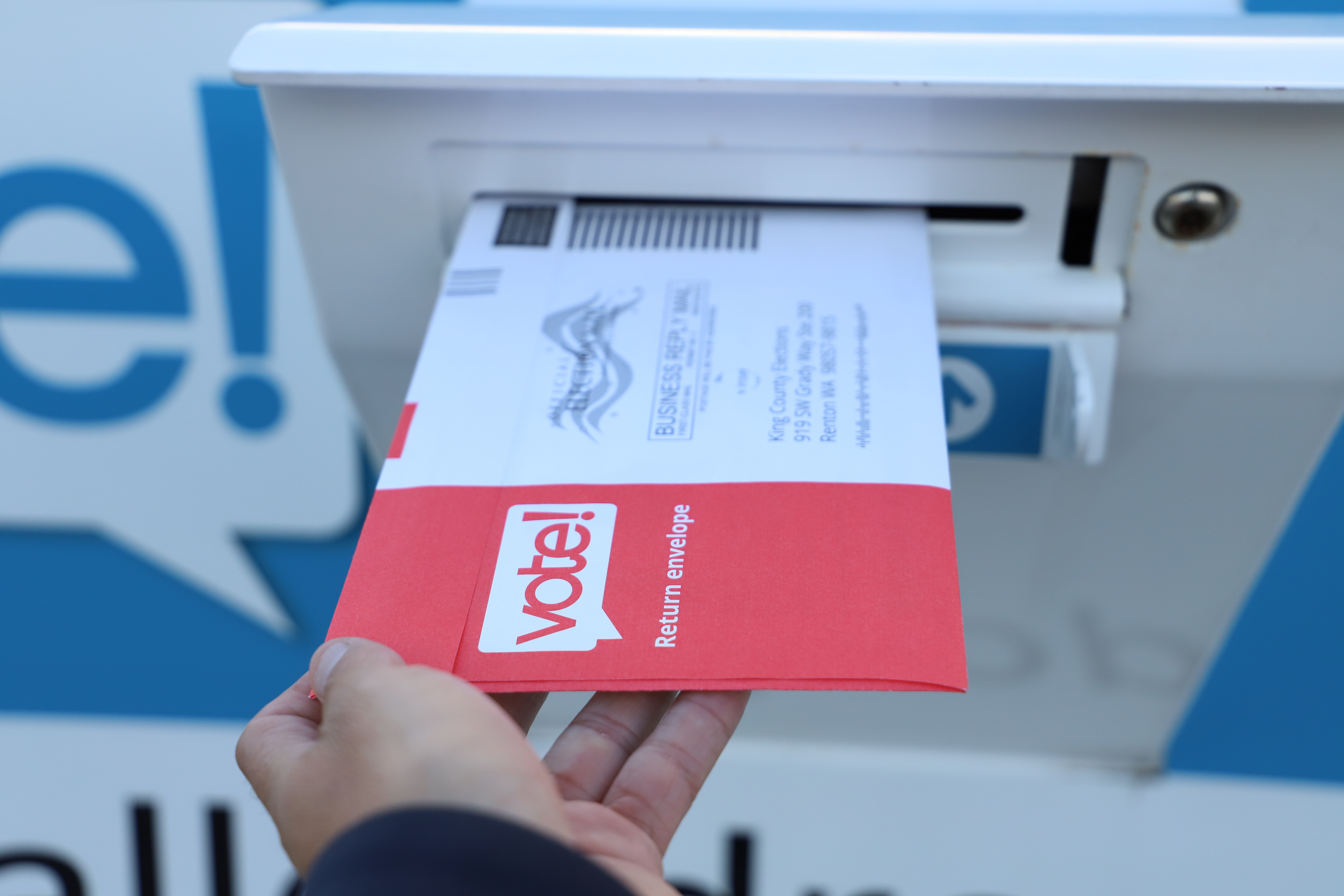
Voting infrastructure also played a part. New ballot drop boxes, including one at the Central Library in downtown Seattle, expanded access. At City Hall, dozens of people leafed through voter guides and filled out ballots for the first time, even though tens of thousands of state residents had voted by mail weeks earlier. A King County elections official called Tuesday the busiest day since the vote center opened on Saturday. “I like voting in person,” said 27-year-old barista Jastrina Villarta. “There’s something ceremonial about it. It’s Election Day.” She even got a free Lime scooter ride as part of an Election Day promotion.
For Villarta, the main motivation was an initiative that would prohibit transgender children from taking part in school sports. “As a lesbian, I think LGBTQ+ issues need to be addressed, especially given current federal policies,” she said. The measure shows how local ballot questions have become an extension of nationwide cultural conflicts.
The numbers bear out the high level of engagement: Washington Secretary of State Steve Hobbs said nearly 1.7 million people had already returned their ballots. The King County Elections Office expects turnout to reach about 75%—higher than is typical for a midterm election. “I’m glad so many people are excited to vote and understand that they have a voice,” said Amber Simmons of Belltown. “But some of the initiatives across the country are a little scary, so I’m doing my part and hoping for the best.” The drop boxes closed at 8 p.m., when the first results from King County were also expected to be released.
A few terms help explain the issues. Midterm elections take place halfway through a president’s term, when members of Congress, some senators and local officials are elected; turnout is traditionally lower than in presidential elections. A sales tax is charged on each purchase and is considered regressive because it places a heavier burden on people with lower incomes: they spend a larger share of their income on consumption. Taxing income above $1 million in Washington has long been controversial: the state has historically relied on sales taxes, making the introduction of a “millionaires’ tax” a notable exception. A voter guide is an official or party-produced booklet explaining ballot measures and candidates’ positions, which voters may consult at a polling place. Ballot drop boxes are a key part of Washington state’s vote-by-mail system: ballots are mailed to voters, but can be returned to designated boxes, a convenient option for people who do not want to rely on the postal service or are voting on the final day.
The main takeaway from the report is that Seattle’s election was less about party politics than about tax fairness, access to transportation and LGBTQ+ rights. High turnout and lines at new drop boxes suggest that local issues can mobilize voters as much as federal ones. Voters also showed a nuanced ambivalence: they support progressive goals but criticize the tools used to achieve them—whether a regressive sales tax or repealing a tax on the wealthy. These trade-offs will shape city and state policy in the years ahead, while the first King County results, released Tuesday evening, will offer an initial indication of whose arguments proved more persuasive.
“Keeping our powder dry”: the Seahawks aren’t done making trades
Seattle Seahawks general manager John Schneider has made clear that the blockbuster deal to acquire six-time Pro Bowl guard Quenton Nelson from the Indianapolis Colts is not the end of the team’s activity in the trade market. He said Seattle is continuing talks with several teams ahead of the November 10 deadline, which falls at 1 p.m. local time. Schneider spoke about it in a pregame interview with broadcast commentator Steve Raible on the Seattle Radio Network, which includes Seattle Sports 710 AM.
“We’re still talking to several teams,” the general manager said. “Most teams are actually going to wait until the deadline itself... We talk about improving the team throughout the year, and about keeping our powder dry a little bit.” The expression “keeping your powder dry” means conserving resources and flexibility rather than using up every advantage too soon, leaving room to make a better move. In other words, the Seahawks are deliberately holding back, preserving their options in case a more attractive opportunity emerges closer to the deadline.
The Nelson deal came about through Schneider’s relationship with Ed Dodds, a former Seahawks scout and executive who recently became the Colts’ interim general manager after Chris Ballard was fired. Dodds worked in Seattle from 2007 to 2016, including seven seasons alongside Schneider. “Knowing Ed Dodds as well as we do, and given everything that’s happened there with Chris Ballard, we’re trying to be involved in as many processes as we can,” Schneider said. “Obviously, to get a player with that level of talent, and a leader, a fighter and all that... I told him we didn’t really have a chance to get to know him well as a person because we never had the chance to draft him. But it’s a great deal. We feel blessed that we were able to get involved so quickly.” The deal illustrates the importance of personal connections in the league: Schneider’s familiarity with Dodds sped up negotiations and allowed Seattle to move quickly.
With Nelson now on board, three positions stand out as logical targets for further upgrades: running back, wide receiver and edge rusher—a defensive player tasked with pressuring the opposing quarterback from the edge of the line. But with Zach Charbonnet and first-round pick Jadarian Price returning on Monday night, the priority is likely shifting to wide receiver and edge rusher. In a recent ESPN article on the 25 most available trade candidates, Indianapolis running back Jonathan Taylor and Tampa Bay edge rusher Yaya Diaby were named as good fits for Seattle. The only other running back on the list was Tennessee’s Tony Pollard. Other edge rushers mentioned included Khalil Mack of the Chargers, while Jacksonville’s Brian Thomas Jr. topped the list of available wide receivers.
The context matters: these updates come amid references to losses to Chicago. Commentators say the Bears’ defense “flipped the script” against Seattle, while Brock Huard says the Seahawks had “no answers” for the Bears. Against that backdrop, the team’s efforts to strengthen its roster stand out: management has not accepted the setback but is looking for ways to improve the team now. The main takeaway is that Seattle sees a real opportunity in the current window, is willing to spend assets to strengthen the roster and is acting pragmatically—relying on trusted connections while waiting until the deadline. The key uncertainty is whether the team can complete deals at its priority positions in time, since, as Schneider acknowledges, most competitors are saving their final decisions for the last few hours.
Seattle students design the future: how the ACE program turns learning into a career
Seattle Public Schools has announced the launch of a new season of the ACE Mentor Program, an initiative that has introduced high school students to architecture, construction and engineering for many years. This year, more than 400 students across nine regional teams are taking part, and the kickoff ceremony was held at Cleveland High School. It is more than an elective: students get an immersive introduction to the professions, meeting industry mentors, visiting real job sites and developing their own building project over the course of the year—from the initial idea to the final presentation. On the surface, the story reads like a report on a school event, but it points to a much bigger effort to bridge the gap between the classroom and a construction site, design office or developer’s workplace.
The ACE (Architecture, Construction, Engineering) program is a national initiative supported in Seattle by the Career and Technical Education (CTE) department—the school district unit responsible for vocational education. The idea is simple and effective: rather than offering abstract talks about “careers of the future,” students are given a concrete task—designing a building. Along the way, they follow the steps familiar to any designer: discussing a concept, sketching, calculating, securing approvals and presenting to a client. At every stage, they are supported by a mentor—a practicing architect, engineer, construction manager or skilled trades professional. Importantly, the program is not limited to white-collar jobs: it shows that modern construction depends on welders, installers and site supervisors too, broadening students’ understanding of the careers available to them.
The format of the sessions is worth noting. Teams meet weekly not at school but in the offices and workplaces of partner companies. This changes the learning environment: students find themselves in a place where people discuss schedules, budgets and technical constraints, rather than grades and homework. The program also includes visits to active construction sites—what educators call the “real world,” and what can often replace dozens of hours of theory. As a result, students do not just learn what a structural engineer does; they see how that person’s decisions affect concrete, steel and the construction schedule.
One of the most telling details is that some mentors say they were ACE participants themselves. It is a virtuous cycle of mentorship: the program not only supplies workers to the industry but also builds a community in which former students return as professionals. For a teenager, such a mentor is living proof that the path from school to a job at a design firm is achievable and does not require extraordinary effort. Psychologically, that can be more powerful than any career-guidance brochure.
The program culminates in May, when teams present their final projects. It is essentially a miniature thesis defense: students must not only come up with a solution but explain it, defend it before an audience and answer questions. This is where the skills listed in the news release—collaboration, communication, problem-solving and project management—come into play. These are not abstract “soft skills” but practical abilities tested through teamwork on a building project: agreeing on how to divide tasks, meeting a deadline, persuading a teammate and acknowledging an error in a calculation.
More broadly, Seattle’s program reflects a national trend in American education: an emphasis on career-connected learning. Through its CTE department, the district is effectively integrating businesses into the educational process: companies get motivated potential interns and early visibility, while schools gain up-to-date expertise and equipment they do not have themselves. More about the program launch is available in the Seattle Public Schools news release. The model does have a weak point: it depends heavily on businesses being willing to devote employees’ time to mentoring. Where such partners are unavailable, students may have to make do with presentations and videos.
In short, the figures are nine teams, more than 400 participants, weekly meetings throughout the school year, site visits and a final presentation in May. Behind those numbers are hundreds of teenagers trying on the role of designer for the first time and perhaps realizing for the first time that someone imagined and built the city around them. That may be the program’s most important result: it turns architecture and engineering from abstract school subjects into tangible professions students can experience firsthand—and perhaps choose for life.