
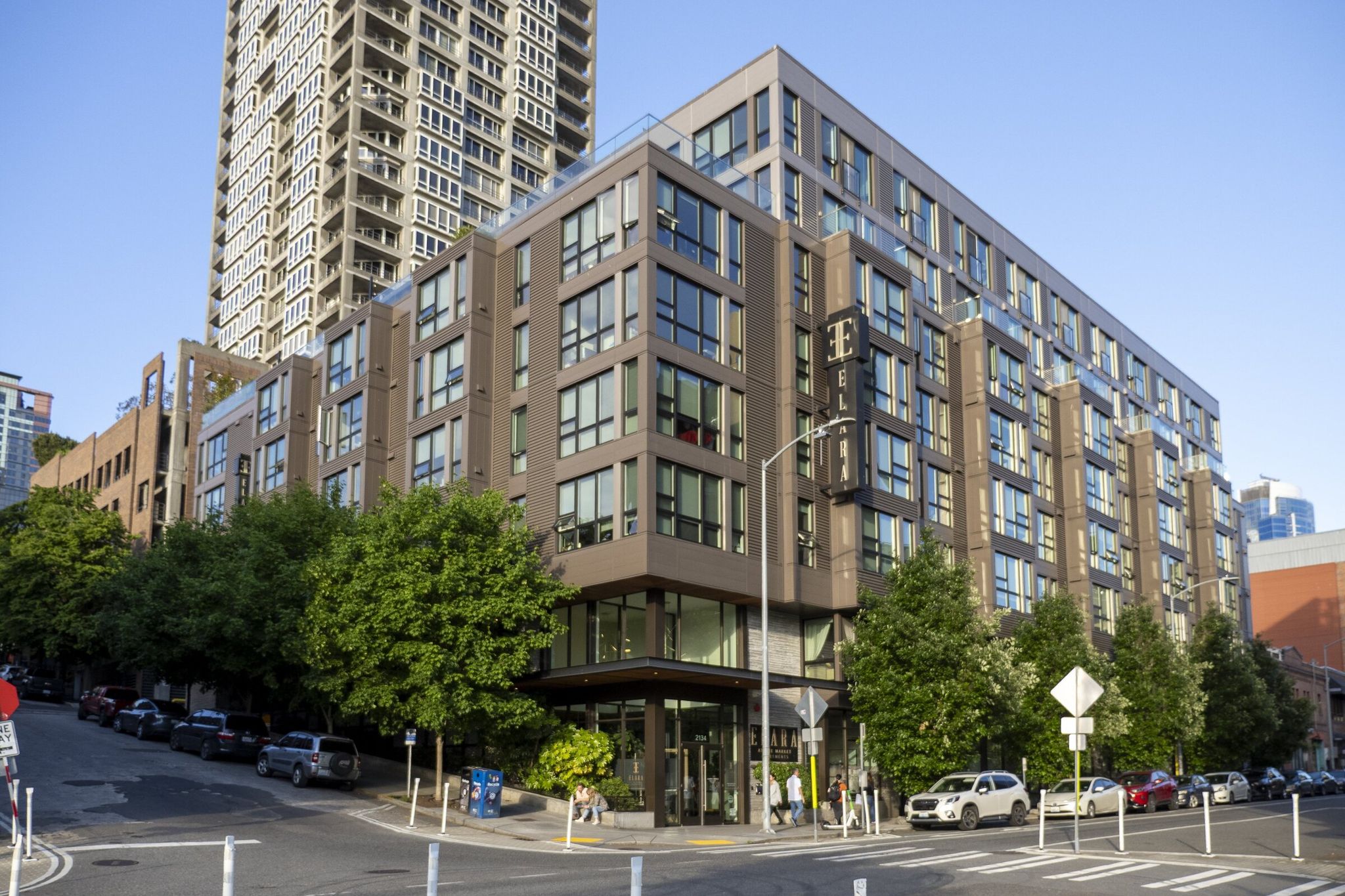
More than 10,000 people applied to live in Seattle’s first social housing building, underscoring the acute shortage of affordable housing in one of the most expensive cities in the U.S. The new project, carried out by the public developer Seattle Social Housing Developer, is converting the luxury Elara at the Market complex in Belltown into a pilot of a model popular in Europe.
Belltown was not chosen by chance for the first social housing site: this lively downtown neighborhood bordering Puget Sound is known not only for its nightlife, arts scene and pricey condominiums, but also for stark social contrasts, including one of the highest concentrations of people experiencing homelessness and tent encampments. On one of the city’s fastest-appreciating parcels, vacant land and proximity to transit hubs make the pilot especially visible as a demonstration of the new model’s effectiveness.
Unlike traditional affordable housing, the social housing building brings tenants with different income levels together in one building. The central idea is to subsidize rent for low-income residents, reduce economic segregation, and permanently preserve affordability. In the first phase, those most in need move in: during a two-week lottery that ended Friday, a record number of applications were submitted.
The lottery process is staged: apartments are first offered to people earning up to 30% of the median income (about $34,500 a year for a single person) — for 15 available units. Then the right moves to those earning up to 50% of the median ($57,500) for the next 45 apartments. As vacancies open up, the building will be made available to residents with higher incomes.
Application statistics are striking: 70% of applicants fall into the lowest income group, meaning more than 7,000 people are competing for 15 units. About one in five applicants earns between 30% and 50% of median income. On Monday the developer will begin a random drawing; winners will have 72 hours to respond and will be required to verify their incomes.
Such fervor reflects the scale of the problem: state projections show Seattle needs more than 100,000 new homes of all types over the next two decades, with more than half needed for low-income households. Private builders can supply middle- and high-tier housing, but affordable options almost always require public subsidies — precisely what the new model aims to address.
Traditional affordable housing programs in the U.S. (such as Section 8 housing vouchers or LIHTC tax credits) are often inefficient due to bureaucracy, market constraints and land scarcity. So the city created the Public Social Housing Developer — a nonprofit organization that directly builds and manages housing not tied to market rents. This allows apartments to be rented at cost rather than at market rates, and to remain permanently affordable for low- and moderate-income families.
Project funding comes from the "JumpStart Tax" — an income tax on large companies whose annual payroll exceeds $1 million per employee. This progressive tax applies to corporations that pay high salaries (for example, Amazon, Microsoft, Starbucks) and is levied on annual pay above the $1 million threshold; the higher executives’ pay, the higher the rate. Funds are directed to finance affordable housing, social programs and homelessness efforts, helping address gentrification driven by the booming tech sector.
The developer, which has already spent about $61 million to purchase the building, plans to bring 1,670 apartments online over five years. Despite criticism (using public funds for higher-income tenants and challenges at launch), proponents emphasize that removing housing from the private market provides long-term public benefits. Current Elara tenants will be guaranteed no rent increases for two years and will receive free transit passes.
Based on: Seattle’s first social housing building draws more than 10K applicants