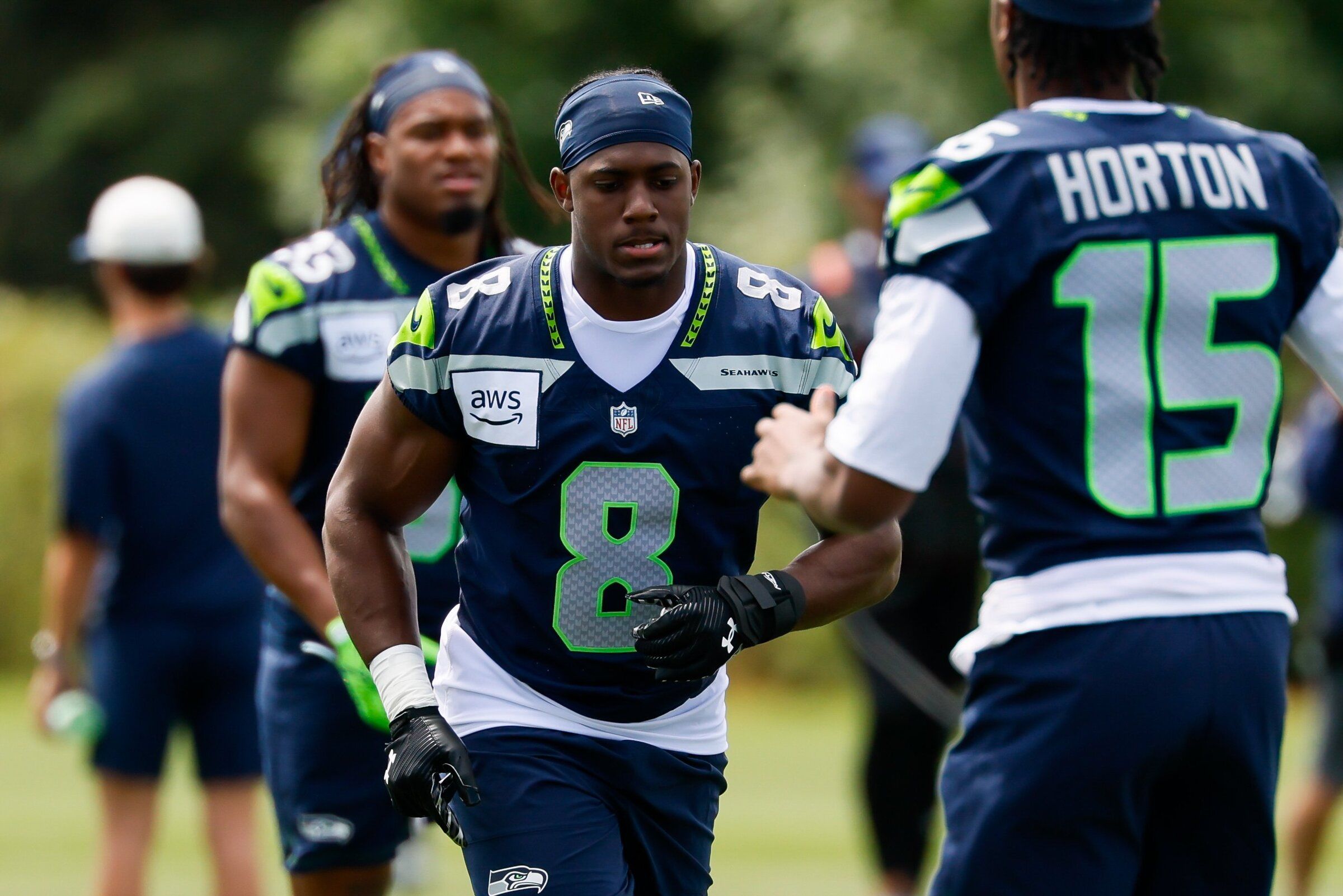
In today’s Seattle news digest: Seahawks rookie running back Jadarian Price is impressing in workouts, new offensive coordinator Brian Flèury brings a distinctive view of the game, and two thrill-seekers made an illegal parachute jump from the Space Needle’s observation deck.
Jadarian Price keeps impressing at Seahawks training camp
The third day of Seattle Seahawks training camp featured the first use of shoulder pads—an important step toward real football, even though full-contact action is still prohibited. Perhaps it’s symbolic for a team that last season allowed the fewest points in the league and won the Super Bowl: throughout the session, the defense looked sharper than the offense, and the day’s final flourish came on a turnover, when rookie cornerback Michael Dan(s)by intercepted a pass in the end zone after a throw by quarterback Jalen Milroe. Standing by the sideline to watch was former Seahawks legend Richard Sherman.
But the standout story of the day belongs again to rookie running back Jadarian Price, the first-round draft pick tasked with replacing the departed Kenneth Walker III. Price once more separated himself from the rest, just as he did during the first two days of camp. Linebacker Ernest Jones IV, after practice, had nothing but praise: “He’s good. He’s mature beyond his years—you can tell right away. You don’t hear a ton of words from him, but he works. Today he beat me.”
And indeed, Price ran away from Jones on the “wheel” route during the “seven-on-seven” period, caught a pass from Sam Darnold, and racked up a lot of yards. Jones admitted, “Damn route. I think he’s going to help us. He’s doing everything the right way, and he’s got a great group of running backs next to him who are teaching him.”
Head coach Mike Macdonald, commenting on Price’s performance, echoed a longstanding truth about NFL training camps: you can only make final judgments about running backs once full-contact work begins in full pads. In his view, it’s still difficult to evaluate how well Price is finishing runs, but what’s already visible is his determination, ability to move, and speed. Most notable is how Price shows up as a receiver and his understanding of the quarterback’s protection—pass protection. At Notre Dame, where he shared playing time with another first-round pick, Jeremiah Love—who went on to “Arizona”—they didn’t often ask him to do that. Many analysts had pointed to these aspects as his weak spots when the Seahawks selected him with the overall No. 32 pick. But Macdonald is happy: “He does a lot of great things in pass protection, which I value. He has great upside.”
That upside is tied to the fact that Walker is gone and Zack Charbonnet is still recovering from a knee injury suffered in the divisional playoff win over San Francisco on January 18. With the starting lineup at the No. 1 running back spot still featuring George Holani (his third year in the league), Price follows him, along with free agent signee Emanuel Wilson. Still, few doubt Price will have a much bigger role in the offense this season—especially on early downs, which were Walker’s domain last year. If he continues proving that he can be useful in the passing game as both a blocker and a receiver, his chances of staying on the field across all three downs and in two-minute situations—and therefore getting more snaps—will only increase. Macdonald noted that blocking in the passing game requires attention to detail and the ability to think quickly, and Price is showing that, even “boldly putting his head into the scrum,” which the coach values.
Beyond a long reception on Monday, Price also made a play on Sunday, when he had to reach his arms out to catch the ball near the sideline while maintaining his balance. “He’s caught a lot of passes. I think he’s got variety from the backfield. We’ll see. But right now there isn’t anything you’d point to as a weakness—and that’s exciting,” Macdonald summed up.
Other camp updates: rookie cornerback Julian Ne(a)l, drafted in the third round out of Arkansas, left practice mid-session due to an injury to the upper part of his leg. He returned to the sideline with ice but did not continue practice. Macdonald called the injury “minor,” but said Neal will be evaluated. Receiver Tory Horton, who missed the second half of the 2025 season due to a shin injury that required surgery, did not practice on Monday, though he worked on Saturday and Sunday. The coach explained it as part of a gradual return plan after Horton had fully missed the offseason program. Tight end A.J. Barner, who also had surgery in the offseason, isn’t 100% yet, but said he feels good physically and is ready to attack every day. Another receiver, Ir(v)in Charles, missed practice due to an unspecified issue, and linebacker J( a )my(e) Sheriff did not work for a second straight day. DeMarcus Lawrence, as a veteran, was likely given the day off, while defensive lineman Leonard Williams—who rested on Sunday—returned.
Next practice is scheduled for Tuesday; it will be open to fans, unlike Monday’s session. After that, the team gets Wednesday off, and on Thursday full-squad work in full pads begins. Macdonald wants to see better execution on Tuesday, noting that “there’s a lot to work on, and it’s a long road,” but that the focus should be on what they do best and to finish the acclimation period on a high note. All of this was discussed in a Seattle Times article, where the author covers the camp in detail.
New Seahawks offensive coordinator: a perspective different from 99.9% of people
When the Seattle Seahawks try in 2026 to become only the third team in this century to repeat as Super Bowl champions, they’ll be entering the season with nearly the same roster as they had in February’s triumph. Still, one of the key changes is the new offensive coordinator, Brian Flèury, who took over after Clint Kubiak left to coach the Las Vegas Raiders. Flèury, who spent the last seven seasons in Kyle Shanahan’s staff in San Francisco, will become responsible for game-calling in Seattle for the first time. At the same time, he comes from the same “coaching tree” as Shanahan, so the Seahawks will continue using a similar offensive scheme.
Seattle left guard (Gray) Z(a)ble—who last year stepped in for an injured teammate and became a key piece of the offensive line—told Seattle Sports’ Brock and Salk that Flèury is an exceptional specialist. “Brian’s done an incredible job, top to bottom,” said Zable. “He wants to build on what we already have, but also add new nuances. He’s the kind of guy who sees football differently than 99.9% of people. It’s really surprising how he understands it—and how he explains it.” Zable emphasized that Flèury gives answers to questions before they even arise, allowing quarterback Sam Darnold and everyone else to play freely—while still having a clear vision.
Flèury’s unique vision is explained by his unusual experience working on both sides of the ball in the NFL. In San Francisco, he was the run-game coordinator, coached tight ends, and earlier had been involved in quality control on both defense and offense. Before that, he worked as an analyst in Miami, coached linebackers in Cleveland, and was an assistant in Buffalo. At the college level, he served as defensive coordinator and coached defensive backs, and he played quarterback himself. That range—from director of football research to linebackers coach—helps him anticipate what the defense will do. As Zable put it: “He sees the defense and the linebackers and coverage differently, and he understands what’s going to happen even before it happens.” That gives offensive players ready-made solutions in tough situations.
Zable, who played a major role in the Seahawks’ success last season, admits that the team is still just starting to tap into what it can do with the new coordinator. “It’s like we’re looking at the top of the iceberg,” he said. “What he’s been able to do in a short time is remarkable.” A full interview with Z(a)ble can be heard on the Seattle Sports website or on the Brock and Salk podcast, where they discuss new schemes and the Seahawks’ outlook. The original article makes clear that Seattle’s success in 2026 will depend not only on roster stability, but also on how effectively Flèury can apply his unconventional way of seeing the game.
A daring Space Needle jump: two extremists broke the law for adrenaline
On Friday evening, an incident at Seattle’s famous landmark, the Space Needle, drew the attention of police and extreme-sports fans alike. Two men gained access to the 184-meter tower’s observation deck, climbed over the glass railing, and made a parachute jump. Authorities have already begun searching for the offenders, who face charges of unlawful entry.
As reported by Associated Press, the incident occurred at around 8:50 p.m. local time. The men bought tickets and entered the Space Needle like regular visitors. Surveillance cameras captured the pair heading to the upper level, then going into a restroom, and coming out wearing helmets. After that, they rushed to the glass railing, climbed over it, and jumped down. Security was unable to determine the exact landing spot, and police were not able to apprehend the offenders. The descriptions of the suspects were sparse: white men, around 30 years old. Their identities have not been confirmed yet.
These jumps fall under the category of BASE jumping, an extreme sport in which a parachutist jumps from fixed objects—buildings, antennas, bridge spans, or cliffs (the name comes from the first letters of the English words Building, Antenna, Span, Earth). Unlike traditional skydiving, BASE jumps require a high degree of accuracy and are often made from relatively low heights, significantly increasing the risk.
The Space Needle is a symbol of Seattle—a 184-meter tower built for the 1962 World’s Fair. Its observation deck is open to the sky but surrounded by tall glass panels. That’s what the thrill-seekers overcame. Notably, representatives from the Space Needle have not yet responded to requests from journalists, and police continue their investigation.
The incident once again raises questions about safety at popular tourist attractions. While BASE jumping itself is not necessarily a criminal offense, a jump from private property without permission is typically classified as unlawful entry. In this case, that is the charge the men could face. Seattle authorities, judging by a post in AP News, appear to be taking it seriously: they are actively searching for the daredevils. It’s not yet known whether they managed to leave unnoticed, but the fact of the daring jump has already attracted attention from both adrenaline lovers and law enforcement.