Three pieces cover entirely different events—a news helicopter crash in Los Angeles, a crisis in the U.S. federal firefighting service, and NFL teams preparing for the second week of the season. Yet they share one theme: how professional systems respond to heightened risk, limited resources, and the need to make decisions with incomplete information. In every case, the cost of error is high, and safety depends not only on individual skill but also on the quality of management, the allocation of resources, and an organization’s ability to recognize the limits of its capabilities in time.
The NBC Los Angeles helicopter crash was a tragic reminder that covering emergencies is itself dangerous work. Firefighters, by contrast, face risks directly every day, but a Guardian article shows that systematic overwork turns individual hazards into a structural crisis. ESPN’s piece demonstrates a less dramatic but similar dynamic in sports: injuries, uncertainty, and a lack of ready replacements force teams to constantly reassess their decisions. What these stories have in common is not the accidents, fires, or games themselves, but the extent to which outcomes depend on how well a system is prepared for unexpected failures.
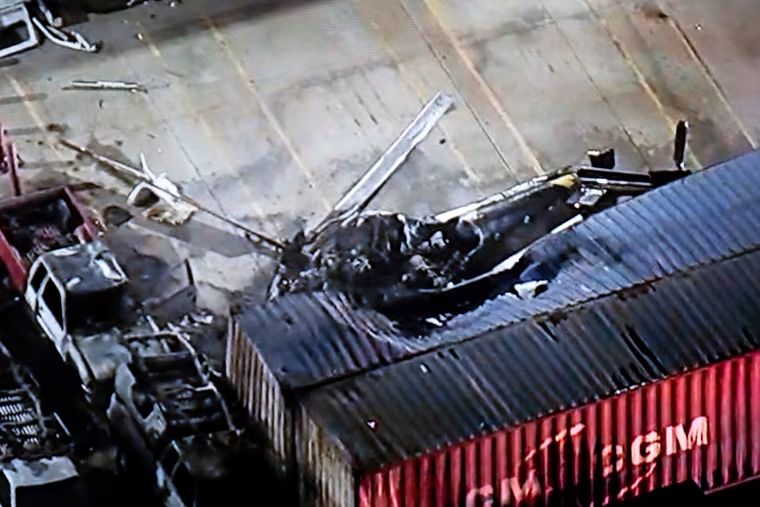
According to an NBC News report on the helicopter crash, the aircraft, which was providing footage for NBC Los Angeles and the Spanish-language station Telemundo 52, crashed Tuesday evening in the Chatsworth area. Photojournalist Eliana Moreno, pilot George Marciniv, and a person on the ground were killed. Two other people were taken to the hospital.
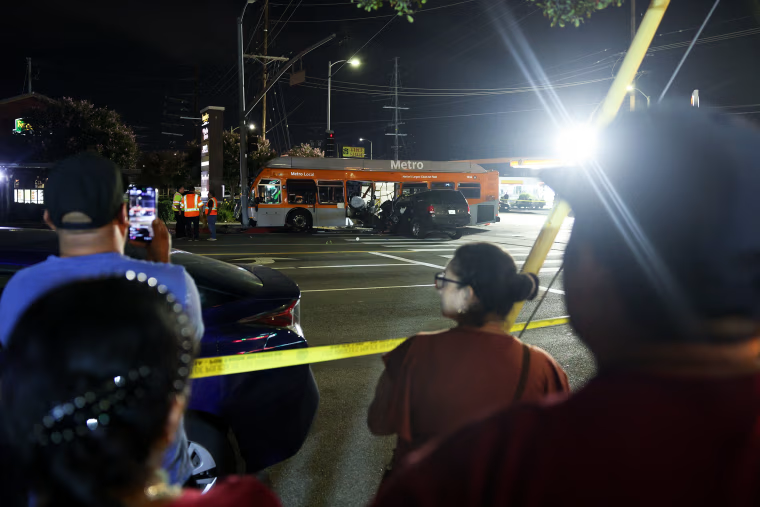
The helicopter was performing a routine task for news stations—transmitting images from the scene of an incident. Shortly beforehand, a Los Angeles Metro bus and a passenger vehicle had collided there, killing two people. Thus, one emergency became the immediate context for another. The news helicopter was among several aircraft covering the crash and then suffered a disaster of its own.
Witness Zareh Sevanehsian said the helicopter was “getting lower and lower” and was “swaying” before it went down. A major fire broke out after the crash and spread to parked vehicles. These accounts are important not only as descriptions of the flight’s final seconds but also as a reminder of the complexity of working in a densely populated urban environment. Aerial footage makes it possible to obtain information quickly, but flights over accident scenes require strict control, coordination, and assessment of weather, technical, and operational factors.
The cause of the crash had not been determined at the time of publication. The Federal Aviation Administration said it was participating in the investigation, which is being led by the National Transportation Safety Board. The helicopter was identified as a Eurocopter AS 350 B2. Mentioning a specific model does not mean that a design defect was responsible: aviation accident investigations typically examine several areas at once, including the aircraft’s technical condition, crew actions, weather conditions, maintenance, weight and balance, route, and interaction with air traffic control.
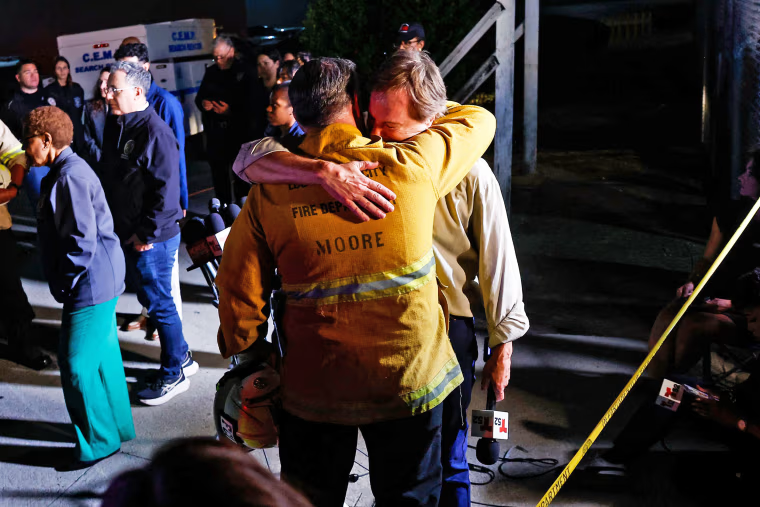
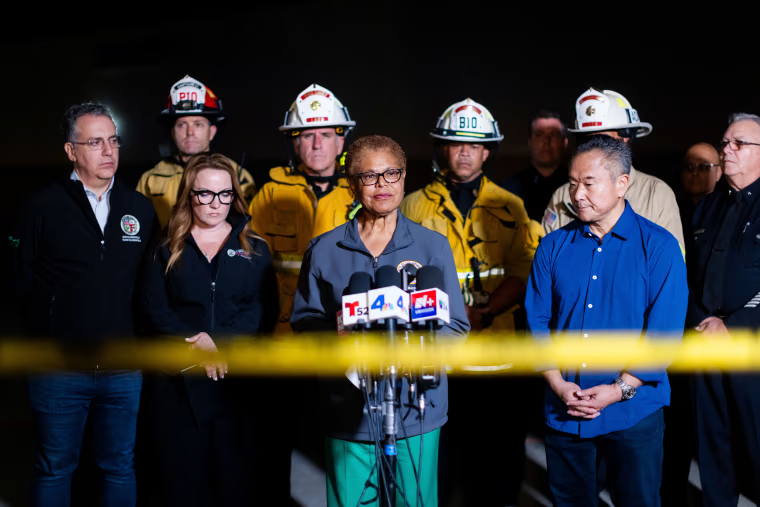
For NBC Los Angeles, the tragedy was not only a professional loss but also a deeply personal one. Anchor Colleen Williams, announcing the deaths of her colleagues, said: “We need a few minutes to process this, grieve and regroup.” The following morning, Lynette Romero described the employees as “people who loved breaking news and loved working in News Chopper 4.” These words illustrate the dual nature of such work: dedication to the profession can provide psychological support, but it can also normalize constant exposure to danger.
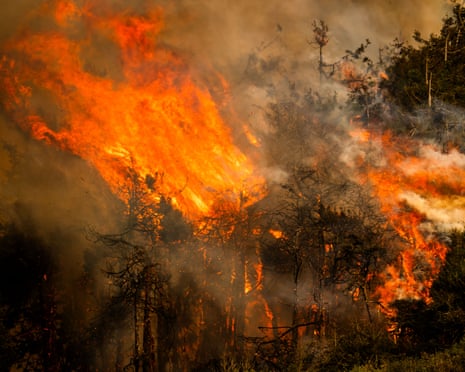
That boundary between professional motivation and acceptable risk lies at the center of The Guardian’s investigation into U.S. firefighters. According to the article, federal firefighting units are facing severe staffing shortages, particularly in leadership positions, while the wildfire season has become significantly more intense and prolonged.
By mid-August, there had been 12 instances in which firefighters became trapped by fire—meaning flames entered a designated safety zone or blocked escape routes. That was the highest figure in two decades. In addition, 14 line-of-duty deaths had been reported during the current season. Among those killed were three firefighters who died while battling the Knowles Fire in Colorado; another team member later died from injuries, while a fourth suffered severe burns.
The gap between the official assessment of the situation and firefighters’ own accounts is particularly troubling. U.S. Forest Service Chief Tom Schultz said the agency was “fully staffed and equipped” to respond aggressively to any fire. But firefighters who spoke to The Guardian on condition of anonymity described excessive hours, a shortage of crews, and a lack of qualified leaders. One said: “Accidents have increased dramatically,” adding that many employees had been working fires almost nonstop since April.
Retired fire chief Bobby Scopa put the problem even more precisely: “We’re not trying to add bureaucracy—we’re trying to keep people alive.” Leaders of major operations, division supervisors, and heavy-equipment specialists require decades of experience. When these people are in short supply, duties begin to overlap and decisions are made under conditions of overload. As a result, danger arises not only from the intensity of the fire but also from the weakening of the management structure.
Firefighters are also criticizing the Donald Trump administration’s push to suppress fires as quickly as possible. Agriculture Secretary Brooke Rollins and Interior Secretary Doug Burgum have supported more aggressive use of direct-attack tactics, in which firefighters work directly along the fire’s edge. Under certain conditions, this can stop flames from spreading quickly, but a sudden change in wind or fire behavior greatly increases the risk of a crew being surrounded.
Experts estimate that firefighters already contain about 98% of fires before they spread on a large scale. Critics argue that trying to extinguish the remaining percentage at any cost could lead to unnecessary deaths. Scopa warns: “We’re going to kill people trying to put out the last couple of percent, and we’re going to spend a lot of money doing it.”
This debate is linked to the broader challenge of wildfire management. As the climate changes, heat, drought, and the accumulation of combustible vegetation are creating fires that are becoming faster and more intense. Some experts propose allowing certain remote fires to burn out in a controlled manner if they do not threaten populated areas and intervention would be too dangerous. Such a strategy conflicts with a policy of “full and rapid suppression,” but it could reduce the amount of vegetation available to fuel future disasters.
The statistics underscore the scale of the burden: approximately 54,400 fires have destroyed more than 8.4 million acres, or 149% of the 10-year average. The United States remained at Preparedness Level 5—the highest level—for 48 consecutive days. This means firefighting resources were almost fully committed. Even after the danger level declined, thousands of specialists continued working on major fires.
Exhaustion is not a secondary issue here but a safety factor. Sleep deprivation, smoke, poor nutrition, and prolonged exposure to heat impair the ability to analyze situations quickly and make decisions. Fire ecologist Timothy Ingalsbee noted that this “affects the ability to think clearly and act decisively to ensure the safety of oneself and one’s team members.” In other words, chronic fatigue turns a human limitation into a systemic risk.
In ESPN’s preview of the NFL season’s second week, the same principle appears in a less deadly but extremely competitive environment. Several teams began the season with injuries to starting quarterbacks, forcing coaches to choose quickly between players with different levels of experience and readiness.
For the Minnesota Vikings, Kyler Murray’s status depended on his completing the concussion protocol. If he was not cleared, veteran Carson Wentz would likely start rather than young J.J. McCarthy. The explanation was not that McCarthy had lost the team’s trust, but that under conditions of limited preparation, a veteran’s experience could prove more valuable. This is an example of a management decision in which potential gives way to predictability.
The Seattle Seahawks were expected to be without Sam Darnold and planned to rely on Drew Lock. At the same time, there was discussion of using Jalen Milroe in certain packages to take advantage of his speed and rushing ability. The Atlanta Falcons faced an even more difficult situation: Tua Tagovailoa suffered an oblique injury, while Michael Penix, who was recovering from his third ACL tear, was not yet psychologically or physically ready to return. This makes especially clear that medical readiness and an athlete’s inner confidence do not always coincide with formal clearance to play.
Similar uncertainty affected the Los Angeles teams. The Rams’ offense scored only seven points, while leading pass rusher Myles Garrett will miss at least a month. The Chargers’ offensive scheme largely unraveled after Ladd McConkey’s injury. ESPN’s writers note that the team must beat the Raiders; otherwise, the questions will concern not just one poor performance but the gap between preseason expectations and the actual quality of play.
In sports, as in firefighting, the key question is how well a system can compensate when one element is removed. An injury to a core player reveals whether a team truly has depth or whether its success depended on a handful of irreplaceable figures. In the Chargers’ case, the loss of one receiver exposed insufficient flexibility in the plan. For the Bills, by contrast, changes under new coordinator Joe Brady were seen as an opportunity to showcase the strengths of Josh Allen, tight end Dalton Kincaid, and other players.
ESPN also emphasizes the importance of adaptation among young professionals. Rookies such as David Bailey, Josiah Trotter, Jadarian Price, and Caleb Douglas quickly attracted attention through strong debuts. But the writers carefully distinguish an early result from sustained success: one game does not prove that a player can consistently withstand the workload over an entire season. This directly echoes the problem facing firefighting services, where temporarily filling a resource gap does not mean the full system has been restored.
The common conclusion from the three sources is that risk rarely arises from a single event. The helicopter crash is being investigated not only through the pilot’s actions but also through the working conditions of news aviation. The high number of firefighter deaths is explained not only by the extremity of the climate but also by staffing shortages, fatigue, management decisions, and fire-suppression policy. NFL teams’ problems are linked not only to injuries but also to roster depth, preparation quality, and coaches’ ability to change strategy quickly.
The concept of “systemic resilience” is especially important. It refers to an organization’s ability to continue operating safely and effectively after an unexpected failure. Resilience does not mean being prepared to work at any cost. On the contrary, it includes reserves of time, personnel, equipment, and authority that allow an organization to reject an excessively dangerous decision. In firefighting, this means being able to avoid sending an exhausted crew into a direct attack. In news aviation, it means having the authority to halt a flight under questionable conditions, even when an editorial desk urgently needs footage. In sports, it means having a plan for the loss of a starting player.
The sources also show the danger of a culture of heroism. Anchors remember the journalists who died as people who loved their work; firefighters continue responding to new assignments despite exhaustion; athletes strive to return after serious injuries. Dedication is an important value, but it should not become a justification for inadequate protection. If a system relies on employees’ personal sacrifice, it gradually begins to view overwork as normal.
The main trend running through all the pieces is the growing mismatch between the complexity of the environment and organizations’ capabilities. Fires are becoming more powerful, news operations are taking place in increasingly crowded and dynamic airspace, and sports seasons demand greater roster depth and medical precision. Old procedures may retain the appearance of effectiveness while no longer providing the same level of safety.
The key question, therefore, should not be “How aggressively can the system act?” but rather “How wisely can it limit itself?” Rapidly suppressing a fire, continuing an aerial shoot, or putting an injured athlete on the field may produce a short-term result, but in the long run it raises the cost of error. Without investment in personnel, training, maintenance, contingency plans, and independent risk assessment, individual tragedies will be treated as accidents even though they are actually symptoms of a recurring structural problem.