Three articles may initially appear to focus on entirely different subjects: the U.S. Supreme Court’s ruling on Missouri’s congressional map, the collapse of the verdict in the Lindsay Clancy case, and the U.S. Open tennis quarterfinals. Yet all three texts return to one common theme—the limits of systems’ resilience when they must make decisions under intense pressure, incomplete certainty, and high consequences for error.
In Missouri, the issue is the collision between courts and electoral procedures. In the Clancy case, it is how a single juror can block a collective decision in a tragic criminal case. On the court, the same problem appears in individual form: athletes must maintain control, recover from setbacks, and perform when their physical and psychological resources are nearly depleted. All three stories show that outcomes are determined not only by formal rules or preparation, but also by participants’ ability to follow procedures, defend their positions, and adapt to crises.
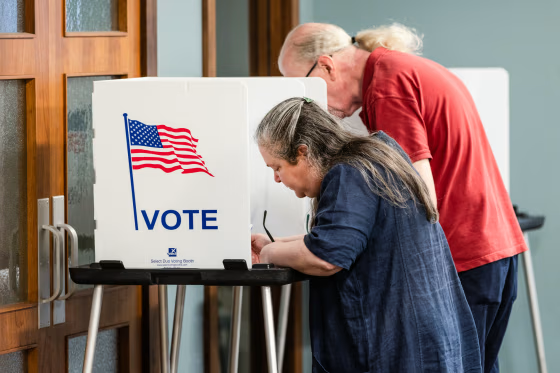
The NBC News article on the Supreme Court’s Missouri ruling describes a dispute over a new congressional map adopted by the state’s Republicans. The U.S. Supreme Court blocked an attempt to use the map in the election, effectively leaving the previous 2022 map in place. Under that map, Republicans hold six House seats and Democrats hold two. The new map was intended to eliminate one of the Democratic districts, represented by Emanuel Cleaver.
Formally, the dispute concerned a technical question: which map should be used in the election? But its political significance is much broader. Redistricting, or gerrymandering, is the process of changing electoral district boundaries to increase the chances of a particular party or group of candidates. In this case, opponents of the Republican map collected signatures to force a referendum that could suspend its implementation. Missouri Secretary of State Denny Hoskins refused to place the initiative on the ballot, arguing that congressional maps were not subject to the referendum process.
The Missouri Supreme Court, despite having a majority of judges appointed by Republicans, reached the opposite conclusion: the law contained no exception depriving citizens of the right to challenge the map through a referendum. After that, federal Judge Stephen Clark ordered the new map to be used because voters had already voted under it in the primary. The U.S. Supreme Court halted that order. The brief ruling did not include any separate opinions from the justices—that is, no public dissent from the decision.
The key conflict here arose not only between Democrats and Republicans, but also between different levels of government. The federal court’s decision contradicted the position of the state’s highest court. The secretary of state and his attorneys argued that canceling the new map could result in the “disenfranchisement of hundreds of thousands of voters” who had already participated in the primary. The Donald Trump administration also supported this position, warning that intervention by the U.S. Supreme Court would threaten the state’s ability to conduct federal elections on schedule.
Opponents of the map, by contrast, invoked the rule of law. Richard von Glahn, leader of People Not Politicians, called the situation straightforward: “The law is the law, the Missouri Constitution is clear, and so is the Missouri Supreme Court.” Ultimately, the U.S. Supreme Court prioritized preserving the existing legal procedure over attempting to justify actions already taken on the grounds that the election calendar had to be met.
This episode demonstrates an important institutional problem: electoral procedures depend not only on political decisions, but also on strict compliance with deadlines. When an official delays a decision until the last moment, legal uncertainty begins to affect the outcome itself. Even if the new map has already been used in a primary, that does not necessarily make it lawful. At the same time, returning to the old map also creates practical difficulties: ballots must be prepared, and the first election materials in Missouri were scheduled to be mailed as early as September 19.
In this sense, the U.S. Supreme Court’s ruling is not simply a defeat for one political side. It shows that courts may regard compliance with jurisdictional boundaries and procedures as more important than administrative convenience. At the same time, the case highlights the vulnerability of the American electoral system to hurried rule changes made immediately before an election.
The second article, an NBC News account of a juror in the Lindsay Clancy case, shifts attention from government institutions to a smaller but equally significant system of collective decision-making—the jury. Clancy was accused of strangling her three children in 2023. The defense argued that she was suffering from postpartum psychosis and did not understand her actions. Prosecutors maintained that she had not experienced psychosis and that the killings had been planned in advance.
After seven weeks of testimony, the 12 jurors were unable to reach a unanimous decision. Following three inconclusive votes, the judge declared a mistrial. This means that the case ended without a final verdict, and prosecutors may seek a new trial.
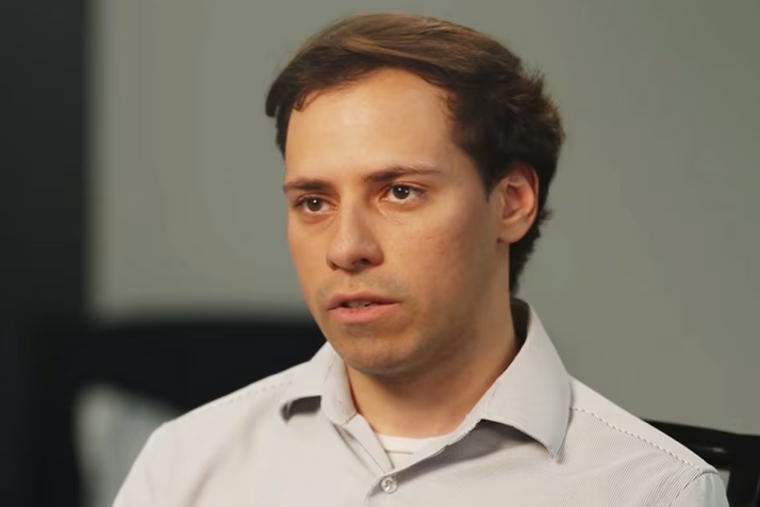
Juror Nick Dargie said that one member of the panel refused to agree with the majority but could not clearly explain which evidence supported his position. According to Dargie, the man browsed his phone and took little part in the discussions. In the most disturbing episode, he wrapped an elastic band around a water bottle and demonstrated on it how the children had been killed. “I was stunned. It made no sense,” Dargie said. He added: “We’re not here to play detective or play Clue. This is serious.”
From a legal standpoint, the position of a single juror is not itself a violation. Unanimity means that every member of the panel has the right to maintain reasonable doubts, even if the others believe the case has been proved. In a criminal trial, the standard is “beyond a reasonable doubt”: the prosecution must convince jurors so thoroughly that rational uncertainty about the defendant’s guilt disappears. The problem described by Dargie, however, was not simply disagreement, but a lack of reasoned participation in the discussion.
Other jurors said that 11 members of the panel leaned toward finding Clancy not criminally responsible. This is a specific form of verdict used when a person committed an act but, because of a severe mental disorder, could not understand its nature or control their behavior. Some jurors had initially considered Clancy guilty. One spoke of a “gray area” and explained that her position changed because she believed a psychiatric facility would be a more appropriate place for treatment than prison.
The trial therefore shows that collective decisions are not always formed through a simple tally of votes. What matters is not only participants’ initial beliefs, but also their ability to reconsider them in light of the evidence. Dargie said that after analyzing the material together, nearly all the jurors arrived at a shared understanding of the case except one person. This detail demonstrates both the power and the limits of discussion: the rational exchange of arguments works only when everyone is willing to take part.
The emotional burden was also a crucial factor. Dargie, who had served overseas, admitted that he was haunted by the recording of the 911 call made by the children’s father, Patrick Clancy. “I’ve never heard anything like it—a scream that came out of a human being,” he said. The disturbing evidence affected not only the public, but also those required to remain impartial. This helps explain why jurors find it difficult to separate legal judgment from human emotion, even though that separation is required by judicial procedure.
The third article—The Athletic’s review of the U.S. Open quarterfinals—examines the resilience of sports systems rather than governmental or judicial ones. In the women’s tournament, the four top seeds—Aryna Sabalenka, Jessica Pegula, Elena Rybakina, and Coco Gauff—reached the semifinals. This was only the second such occurrence in the Open Era after 1968; the first time all four leading women’s players reached the U.S. Open semifinals was in 1975.
The fact has statistical significance, but the authors also use it to illustrate the resilience of favorites. Each of the four athletes encountered difficulties: Sabalenka occasionally lost emotional control, Rybakina struggled at times with her forehand, Gauff faced serving problems, and Pegula remained generally consistent but had lost to other elite players at Grand Slam tournaments. Despite these fluctuations, all four managed to continue.
In this context, resilience does not mean an absence of mistakes, but the ability to recover from them. This is how the success of Linda Noskova, who lost to Sabalenka in a tense quarterfinal, is explained. After winning Wimbledon, Noskova said, she temporarily lost motivation: her personal triumph was over, while the tennis calendar continued as usual. Her defeat at the U.S. Open helped her regain a sense of her place among the best. “That kind of loss is good for motivation, although of course it’s bad in itself,” she said.
This idea echoes the story of Alexander Zverev. After the Wimbledon final, he performed poorly at tournaments in Canada and Cincinnati, but regained his confidence in New York. The victory put him into the semifinals of all four Grand Slam tournaments in a single season—an achievement previously accomplished by only eight players. At the same time, Zverev emphasized that confidence “can disappear in an instant.” Even regularly reaching the late stages of tournaments does not guarantee future success.
The men’s draw, by contrast, proved far less predictable. The semifinals will feature Zverev against Karen Khachanov and Frances Tiafoe against Ben Shelton. Here, the contrast between the stability of the favorites and the opportunities opening up for less obvious contenders is particularly clear. Khachanov received his chance after Alexander Blockx was forced to retire because of injury. The Belgian’s body could not withstand the strain: he was experiencing pain in his ribs, leg, and back and decided to withdraw rather than aggravate the injury.
The defeats of Alex Michelsen and Learner Tien also underscore the cost of inconsistency in long matches. Both Americans lost five-set encounters after making strong starts. Michelsen led Tiafoe, but his opponent managed to change the course of the match. Michelsen did not blame himself for a lack of effort: “I did everything right in the fifth set. It just wasn’t enough today.” In professional sport, good decisions do not always guarantee victory. Sometimes the result is determined by a handful of moments, physical condition, or an opponent’s ability to suddenly change the pace.
The common thread running through all three articles is the distinction between the right to hold one’s own position and the obligation to act within a system. In Missouri, the secretary of state had a political objective and cited the need to hold elections on time, but the courts focused primarily on the legality of the procedure. In the Clancy case, one juror had the right to harbor doubts, but was expected to participate in a good-faith discussion of the evidence. In tennis, athletes are free to choose their tactics, but must accept the limitations imposed by their bodies, tournament rules, and psychological pressure.
In each case, the system is tested by a powerful factor that is difficult to incorporate into a collective process. In Missouri, that factor was the political struggle over the district map and the conflict between courts. In the jury trial, it was the uncompromising position of one participant. At the tournament, it was an injury, an emotional downturn, or a sudden change in an opponent’s play. Resilience arises not because a crisis disappears, but because an institution or individual is able to respond to it appropriately.
The articles also demonstrate the importance of time. In Missouri, the court’s decision was made as deadlines for printing and mailing ballots approached. In the Clancy case, seven weeks of testimony proved insufficient to produce a unanimous verdict. In tennis, players must make decisions within seconds, while physical exhaustion can quickly alter the balance of power. The less time remains to correct a mistake, the more important initial procedures and preparation become.
The main conclusion is that resilience cannot be reduced to rigidity or unchanging behavior. Sometimes resilience means preserving the old electoral map to prevent a legal violation. Sometimes it means allowing a juror to disagree with the majority, even if that leads to a new trial. In sports, it means continuing to fight after a defeat—or withdrawing from a match in time to protect one’s health. In every case, resilience combines discipline, the ability to reconsider decisions, and recognition of one’s own limitations.
That is why these three very different stories are connected. They show that a system’s reliability is determined not by the absence of conflict, mistakes, and doubt, but by whether mechanisms exist to resolve them in a civilized way. When those mechanisms work, a crisis becomes part of the procedure. When a participant refuses reasoned dialogue, ignores a court’s authority, or underestimates physical limits, conflict can bring the entire process to a standstill—from elections and criminal proceedings to a sporting match.